

If we talk about the cybersecurity cost then there’s no single sticker price for small business cybersecurity, and any vendor who quotes you one number before asking about your business is guessing. A 5-person Austin company has very different needs than one with 25, 50, or 100+ employees — and even two companies the same size can pay very different amounts depending on what they do, who they work with, and how much risk they’re carrying.
This guide walks through what actually moves the price, what Austin small businesses are typically paying in 2026, for the cybersecurity services and why “doing nothing” has its own cost attached.
What actually drives the price
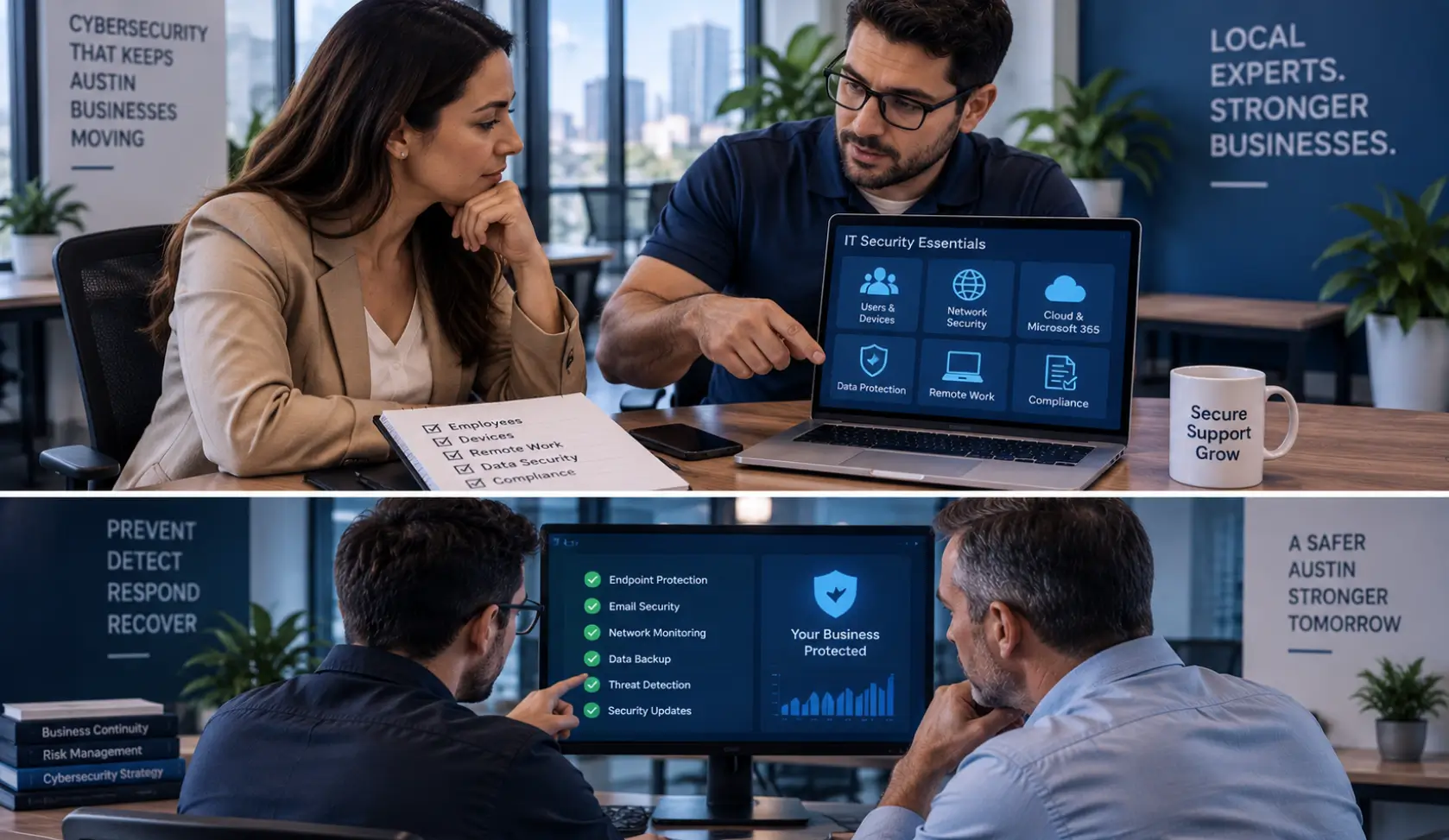
Headcount is the starting point, not the whole answer. The factors that move your quote up or down include:
- Users and devices. More people and endpoints means more to monitor, patch, and protect — the single biggest driver of cost.
- The type of data you handle. A CPA firm holding tax records or a clinic handling patient data carries more regulatory and breach risk than a business with no sensitive data, and that risk gets priced in.
- Remote and hybrid work. Employees connecting from home networks, coffee shops, or personal devices widen the attack surface and typically require additional tools (VPN, endpoint protection, conditional access) to cover safely.
- Your Microsoft 365 environment. Licensing tier, existing security features already turned on, and how well the tenant is configured all affect how much additional protection is needed.
- Cyber insurance requirements. Most carriers now require specific controls before they’ll issue or renew a policy — more on this below — and meeting those requirements is its own line item. Carriers now mandate strict prerequisites before binding coverage; see what underwriters look for in our guide on whether your Austin business is ready for cyber insurance.
- What you already have in place. A business starting from bare antivirus needs more built than one that already has managed endpoint protection and backups.
Typical price ranges
Most managed cybersecurity services are priced per user per month, though some providers price per device or bundle security into a flat managed IT fee. Pricing scales with how much protection is in place — a lean setup with the essentials covered starts much lower than a fully managed, 24/7-monitored, compliance-ready environment.
Treating security as a purely technical line item is dangerous because cybersecurity is an executive team effort that directly protects company revenue and reputation.
As a rough 2026 benchmark, per-user pricing commonly runs somewhere in the $20 to $300 per user, per month range, with the low end covering baseline protection and business-hours support and the high end covering 24/7 monitoring, advanced threat detection, and compliance support.
One more reason quotes vary so much: not every price is for security alone. Some plans bundle in your Microsoft 365 licensing and day-to-day IT support alongside the cybersecurity protection, while others quote security as a standalone add-on to IT you already have in place. A higher number isn’t necessarily a more expensive security plan — it may simply be covering more.
| Company size | Illustrative monthly range |
|---|---|
| 5 users | $100 – $1,500 |
| 25 users | $500 – $7,500 |
| 50 users | $1,000 – $15,000 |
| 100+ users | $2,000 – $30,000+ |
These are planning ranges, not quotes — your actual number depends on the factors above and on what’s bundled into the plan. Onboarding, major projects, and incident response are often billed separately from the ongoing monthly fee, so it’s worth asking any provider what’s included and what isn’t.
What cyber insurers now require
If your business carries (or is applying for) cyber insurance, your policy is quietly setting your cybersecurity budget for you. Insurers increasingly require, before they’ll write or renew a policy:
- Multi-factor authentication on email, financial systems, remote access, and admin accounts
- Endpoint detection and response (EDR), not just traditional antivirus, with real-time monitoring
- A 3-2-1 backup strategy — three copies of your data, on two types of media, with one copy offsite — plus regular restoration testing
- Annual security awareness training for employees, including phishing simulations
- Patch management, with critical patches applied quickly and documented
Meeting these isn’t optional if you want coverage, and it isn’t a one-time purchase — insurers increasingly ask for ongoing documentation, not just tools in place. Businesses that already have a managed provider handling this tend to sail through renewal; businesses that don’t often discover the gap during a claim, which is the worst possible time.
The cost of doing nothing
It’s worth weighing these numbers against the alternative. Small businesses are now a primary target, not an afterthought: the large majority faced at least one cyberattack in the past year, and small and midsize businesses see meaningfully more confirmed breaches than large enterprises do.
When an incident does hit, most small business owners say they doubt their company could keep operating through a serious ransomware event. Budgeted, proactive cybersecurity is a predictable monthly cost; an incident is an unpredictable — and often much larger — one.
How BCS prices cybersecurity for Austin businesses

Business Communication Solutions provides cybersecurity services for small and medium-sized businesses across Austin, Texas. Rather than starting from a generic package, we start with a look at your current environment — your users, your data, your Microsoft 365 setup, and any insurance or compliance requirements you’re working against — and build a plan and a price around that.
Find out exactly where your budget should be focused by requesting a free IT and cybersecurity risk assessment from our Austin technicians.
Curious what cybersecurity would actually cost for your business?
Get a straightforward assessment of your environment and a real number, not a generic package price. Contact BCS to schedule a conversation.
FAQs
Q: What is the typical per-user monthly cost for cybersecurity in Austin in 2026?
A: Small businesses in Austin typically spend between $20 and $300 per user, per month. Basic packages ($20–$60) include antivirus, spam filtering, and patching. Full-scale packages ($150–$300+) feature 24/7 SOC monitoring, MDR, SIEM, and compliance auditing.
Q: Are there one-time setup fees in addition to monthly fees?
A: Yes. Most managed security service providers charge an onboarding fee for initial system auditing, firewall hardening, deploying monitoring agents, and standardizing security policies.
Q: What is the difference between standalone cybersecurity and bundled Managed IT?
A: Standalone cybersecurity covers only security monitoring, antivirus, and incident response. Bundled Managed IT combines these protections with daily desktop support, Microsoft 365 licensing, network administration, and hardware lifecycle maintenance.
Q: How does employee headcount affect total pricing?
A: Because cybersecurity pricing is primarily billed per seat or per endpoint, scaling from 5 to 50 users increases overall investment, although per-seat discounts are often available at higher volume tiers.
Q: Does remote work increase small business cybersecurity costs?
A: Yes. Securing remote employees requires deploying secure VPNs, mobile device management (MDM), cloud access security brokers (CASB), and identity verification tools to protect off-site connections.
Q: What is the financial cost of a small business ransomware attack?
A: Beyond the ransom itself, the average small business incurs thousands in operational downtime, forensic investigations, data restoration, legal fees, and reputational damage.
Q: Can a business with under 10 employees get enterprise-grade security?
A: Yes. Modern cloud-based MDR and SOC-as-a-service platforms allow small companies to access the same monitoring tools as Fortune 500 enterprises without building their own internal security operations center.
Q: Why does cyber insurance affect IT spending so heavily in 2026?
A: Insurance companies now deny policies to businesses that lack MFA on all accounts, endpoint detection and response (EDR), and isolated offline backups, making these tools mandatory budget items.
Related Cybersecurity Articles: