

“We need to be compliant” is where most of these conversations start — but compliant with what? NIST SP 800-53, ISO/IEC 27001, CMMC Level 1, CMMC Level 2 — the alphabet soup of cybersecurity control standards isn’t interchangeable, and building toward the wrong one wastes months and budget. Each standard exists for a different reason, applies to a different kind of business, and asks for a different level of proof.
This guide breaks down what each standard actually is, who it’s really for, and how to figure out which one applies to your business — before you spend a dollar on compliance work.
Why Cybersecurity Control Standards Matter
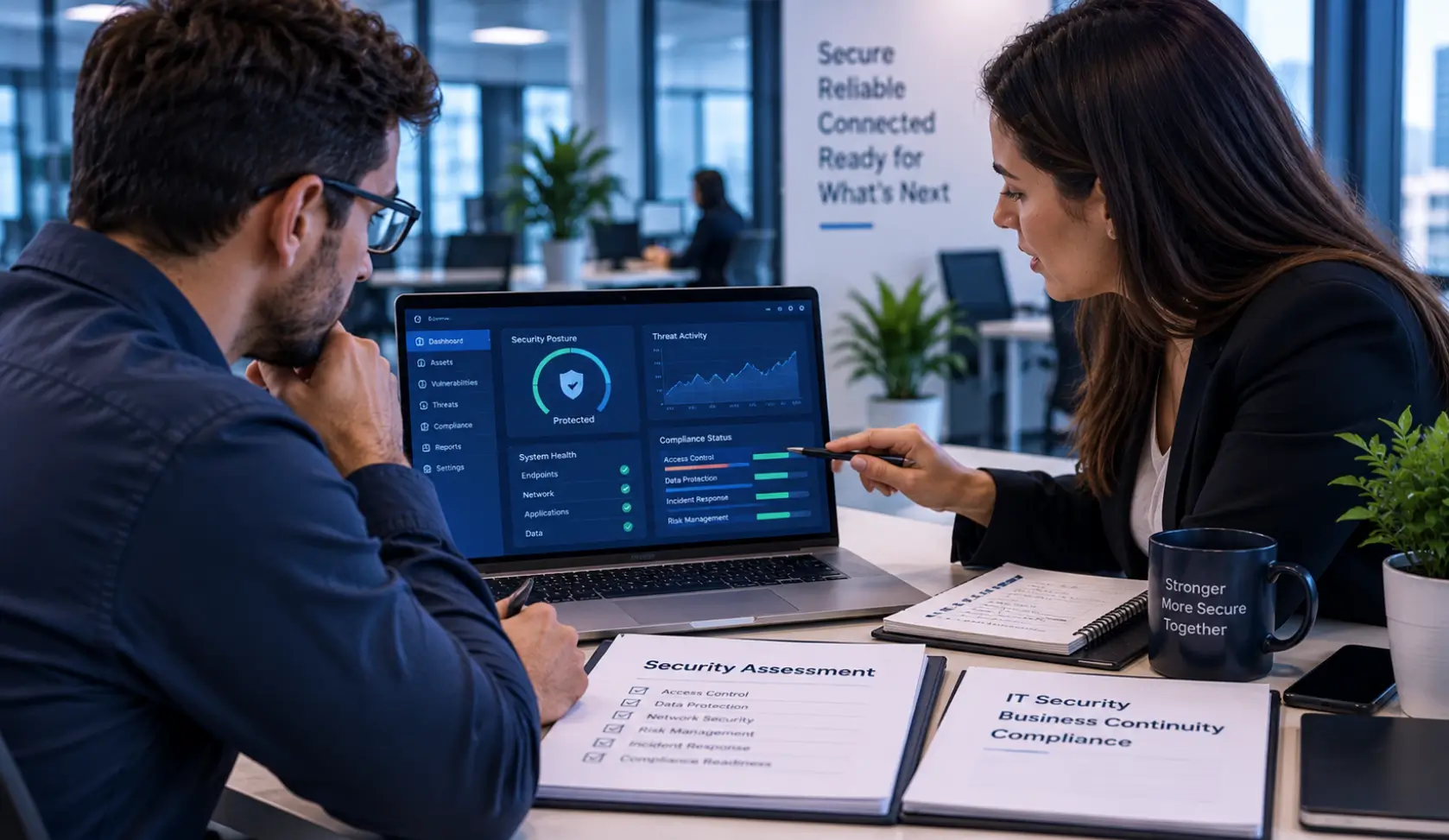
A “control” is simply a documented safeguard — a policy, a technical setting, a process — that reduces a specific security risk. Multi-factor authentication is a control. Encrypting a laptop’s hard drive is a control. A control standard is an organized, third-party-defined list of those safeguards, grouped so an outside party (a customer, an insurer, a regulator, the federal government) can check your business against a known bar instead of taking your word for it.
For small businesses, control standards matter for a few practical reasons: a prime contractor or enterprise customer requires one before they’ll sign a contract, a cyber insurance carrier asks for one at renewal, a regulator or industry body mandates one, or the business simply wants a structured way to know its security program actually holds up. Increasingly, “we take security seriously” isn’t enough on its own — buyers and partners want to see it mapped to a recognized standard.
The standards at a glance
| Standard | Who it’s for | What it protects | How you prove it |
|---|---|---|---|
| NIST SP 800-53 | Federal agencies and their contractors/vendors | Federal information systems and data | Self-assessment or agency-led authorization (ATO) |
| ISO/IEC 27001 | Any business, any industry — often driven by enterprise or international customers | The business’s information generally, via a full security management system | Accredited third-party certification audit |
| CMMC Level 1 | DoD contractors and subcontractors handling only basic government data | Federal Contract Information (FCI) | Annual self-assessment |
| CMMC Level 2 | DoD contractors and subcontractors handling sensitive, unclassified defense data | Controlled Unclassified Information (CUI) | Self-assessment or third-party C3PAO assessment, depending on the contract |
NIST SP 800-53 is the security control catalog NIST built for the federal government under FISMA — over 900 individual controls across roughly 20 families covering everything from access control to incident response. Most small businesses never implement it directly, but it’s worth knowing because it’s the foundation several other frameworks are built on, including the 110 controls in NIST SP 800-171 that CMMC Level 2 is based on.
ISO/IEC 27001 is the internationally recognized standard for building an Information Security Management System (ISMS) — a structured, ongoing program rather than a one-time checklist. The 2022 revision organizes 93 controls into four themes: organizational, people, physical, and technological. Certification requires an accredited external auditor, a two-stage audit, and annual surveillance audits to keep it — which is exactly why it carries weight with customers who see the certificate.
CMMC Level 1 is the entry point for doing business with the Department of Defense. It covers 17 basic safeguarding practices — drawn from FAR 52.204-21 — and applies to contractors and subcontractors who only handle Federal Contract Information, not classified or highly sensitive data. It’s self-assessed annually, with scores reported to the DoD’s Supplier Performance Risk System.
CMMC Level 2 is a significant step up, built on all 110 controls in NIST SP 800-171 across 14 domains. Meeting the 110 controls of NIST SP 800-171 requires strict baseline hygiene; see our guide on achieving NIST certification compliance by 2026 for defense contractors. It applies to contractors handling Controlled Unclassified Information — technical drawings, export-controlled data, and similar — and adds requirements Level 1 doesn’t touch at all, like encryption, audit logging, and formal incident response. Depending on the contract, it’s verified either by self-assessment with leadership sign-off or by a certified third-party assessor (C3PAO).
Which standard does your business actually need?
Before building toward any of these, it’s worth asking a few direct questions:
- Do you hold a DoD contract or subcontract? If yes, the contract itself will specify CMMC Level 1 or Level 2 — it’s not optional or a judgment call.
- Do you handle Controlled Unclassified Information? If you’re touching CUI rather than just basic contract information, you’re almost certainly looking at Level 2, not Level 1.
- Is a customer, investor, or partner asking for proof of a security program, without naming a specific framework? That’s usually a sign ISO/IEC 27001 is the right fit — it’s the standard most recognized outside government work.
- Are you a federal agency vendor outside the DoD supply chain? NIST SP 800-53 (or a subset of it via FedRAMP or similar) is more likely what’s being asked for.
- Is this being driven by a cyber insurance renewal rather than a specific contract? That’s a different conversation — insurers usually want to see specific controls in place, not a named certification, and the right starting point is different from any of the above.
- Do you create, receive, or store patient health information? HIPAA applies by law regardless of the framework above — see our breakdown of HIPAA, NIST SP 800-66, and HITRUST CSF for how that works.
If you’re not sure which of these applies, that’s normal — it’s the single most common question we get asked, and it’s the right first question to ask before signing up for any compliance project.
Control assessments: how you find out where you stand
Whichever standard applies, the starting point is the same: a control assessment — a structured review of what’s actually in place today against what the standard requires, so you know your real gaps before you commit to closing them. It’s the difference between guessing at compliance and having an actual roadmap. We cover what a control assessment involves and how BCS runs one in detail on our dedicated assessment page.
Closing control gaps usually begins with basic hygiene that helps reduce your business attack surface before pursuing formal auditor review.
How BCS helps Austin businesses navigate compliance

Business Communication Solutions works with small and medium-sized businesses across Austin, Texas and provide cybersecurity services to figure out which control standard actually applies to them — and then to build toward it without wasted effort on the wrong framework.
Not sure which standard your business needs to meet?
Get a straightforward answer based on your contracts, customers, and industry — not a generic checklist. Contact BCS to schedule a conversation.
FAQs
Q: What is a cybersecurity control standard?
A: A control standard is a structured framework of technical, physical, and administrative safeguards designed to reduce cybersecurity risk and demonstrate security readiness to partners, clients, and regulators.
Q: What is the difference between NIST SP 800-53 and ISO 27001?
A: NIST SP 800-53 is a comprehensive catalog of federal controls mandatory for U.S. government agencies and their prime vendors. ISO/IEC 27001 is an international standard focused on establishing an Information Security Management System (ISMS) across commercial organizations.
Q: What are the primary levels of CMMC 2.0?
A: CMMC 2.0 has three levels: Level 1 (Foundational, 17 basic controls under FAR 52.204-21, annual self-assessment), Level 2 (Advanced, 110 controls aligned with NIST SP 800-171, third-party C3PAO or self-assessment), and Level 3 (Expert, government-led assessments for high-priority programs).
Q: Can a small business self-assess for ISO 27001?
A: While you can conduct internal audits using ISO 27001 as a benchmark, an accredited external certification body must perform a formal two-stage audit to issue an official ISO 27001 certificate.
Q: What is Controlled Unclassified Information (CUI)?
A: CUI is sensitive government data created or possessed by government contractors that requires safeguarding and dissemination controls pursuant to law, regulations, and government-wide policies.
Q: How long does it take for a small business to achieve CMMC Level 2 readiness?
A: Most organizations take between 6 and 18 months, depending on current security maturity, documentation status, and the complexity of their IT infrastructure.
Q: Do commercial clients accept NIST frameworks instead of ISO 27001?
A: Yes, many enterprise clients accept NIST Cybersecurity Framework (CSF) or NIST SP 800-171 self-assessments with supporting System Security Plans (SSPs) as proof of security rigor.
Q: What is a System Security Plan (SSP)?
A: An SSP is a formal document describing an organization’s system boundaries, operational environment, security requirements, and the specific controls implemented to protect institutional data.
Related Cybersecurity Articles: