

Cybersecurity for a small business can look simple from the outside: buy a firewall, turn on multifactor authentication, install antivirus, and tell the IT person to keep everything secure. In reality, cybersecurity becomes complicated when leadership priorities, budgets, technical responsibilities, and business risk are not aligned.
For many small businesses in Austin, TX, the biggest cybersecurity weakness is not a single missing product. It is the belief that one IT administrator—or one outside managed service provider—can carry the entire responsibility for protecting the company.
A Fictional Story That Feels Familiar
Consider a fictional Austin company that depends on email, cloud applications, customer information, accounting data, remote access, and a growing computer network. The company has an outside MSP serving as its main IT administrator and an internal help desk employee handling everyday support.
The MSP has repeatedly recommended stronger email security, security awareness training, better backups, network segmentation, vulnerability management, endpoint detection and response, and improved monitoring. Leadership agrees that cybersecurity is important—but each recommendation competes with other business priorities.
The CEO Focuses on Results
The CEO is responsible for growth, customer satisfaction, and profitability. At the end of every quarter, the CEO does not want to see disappointing numbers. Because cybersecurity spending usually does not create obvious short-term revenue, upgrades may be delayed unless the business value and potential consequences are clearly explained.
This does not mean the CEO does not care about security. It means cybersecurity may be presented as a technical expense instead of a business risk involving downtime, reputation, contracts, insurance, legal obligations, and the ability to keep operating.
The CFO Sees Another Expense
The CFO may not be deeply technical and has a responsibility to control costs. A request for a next-generation firewall, managed detection and response, security training, cloud backups, or a security operations center can look like a collection of expensive tools.
If the technical team cannot explain which risk each service reduces, what the company is currently exposed to, and what could happen if the request is declined, the easiest answer is often: “Can we wait until next quarter?”
The Vice President Wants to Show Progress and Savings
The vice president leading the IT function wants to show that projects are being completed and costs are under control. That pressure can unintentionally reward visible savings today while pushing less visible security work into the future.
A delayed security project may make a budget report look better. However, leadership should record that decision as accepted business risk—not leave the IT administrator silently responsible for an exposure the company chose not to address.
The Board Holds Authority but May Be Far From the Technology
The situation becomes even more complicated when the business has a board of directors, investors, or owners who control major spending and strategic decisions. The CEO, CFO, and vice president may appear to have authority, but they may have little or no power to approve an unplanned cybersecurity investment, add personnel, replace an aging system, or interrupt operations for a major security project.
The board may receive financial reports and high-level operational updates without seeing the technical warning signs underneath them. Cybersecurity may appear as a cost center, while the consequences of underinvestment remain hypothetical. If security risk is translated into technical language instead of business impact, the board may not understand what it is being asked to accept.
This can create a dangerous chain of diluted responsibility. The IT administrator reports a problem to the vice president. The vice president brings it to the CFO. The CFO raises the cost with the CEO. The CEO takes the request to the board. At every step, the urgency can be softened, the scope can be reduced, or the project can be delayed. Eventually, the answer that returns to IT may be: “Do the best you can with what you have.”
Everyone participated in the decision, but no single person clearly accepted the risk. The board believes management is handling cybersecurity. Management believes the IT provider is handling it. The help desk assumes the main administrator has everything covered. The IT administrator knows important gaps remain but lacks the budget or authority to close them.
That is not a technology problem alone. It is a cybersecurity governance problem.
A Real-World Example: Compliant on Paper, but Can the Business Recover?

We encountered an incident that illustrates how budget decisions, aging infrastructure, and compliance reporting can collide. The business depended on two servers. One was more than ten years old, outside its supported life, and still operating because replacement had been delayed due to budget constraints. The other server’s hard drive had become full.
The full server created an immediate operational problem. The stored data could not simply be deleted without determining retention requirements, ownership, business value, and possible legal or compliance obligations. Additional storage, data archiving, system cleanup, or migration required planning and funding.
At the same time, the backup system needed to be tested. A backup report may show that a job completed, but the real question is whether the company can restore the data and resume operations. In this situation, there was not enough safe, separate capacity available to perform the needed test restore without additional resources. The company had backups, but its ability to prove recoverability was limited.
Management still wanted the organization to appear compliant. But a checked box beside “backups” does not answer the most important questions: When was the last successful test restore? Where was it restored? How long did recovery take? Were the restored applications and data usable? Could the business recover if either aging server failed today?
This is where compliance can become misleading. Documentation may say a control exists while operational conditions prevent the control from being properly validated. An unsupported server, a full production drive, limited restore capacity, and deferred replacement plans are not separate issues. Together, they create a business continuity and cybersecurity risk that leadership and the board must understand and formally address.
The IT administrator should document the condition, the recommended corrective actions, the cost, the urgency, and the consequences of delay. If leadership or the board decides not to fund the work, that decision should be recorded as accepted business risk. It should not remain an undocumented technical problem that is later placed entirely on the IT administrator after a failure.
The Main IT Administrator Carries Everything
The outside MSP serves as the main IT administrator, but the provider is limited by the approved budget, available labor, access, and authority. The same person may be expected to support users, manage Microsoft 365, maintain the network, configure firewalls, protect endpoints, monitor alerts, verify backups, document systems, manage vendors, and respond to emergencies.
Even an experienced IT professional cannot provide unlimited protection with limited time, limited tools, and recommendations that are repeatedly postponed. When everything rests on one person, the company also creates a single point of failure. Who reviews that administrator’s changes? Who verifies that backups can actually be restored? Who checks privileged accounts, firewall rules, security alerts, and exceptions?
Help Desk Support Is Not the Same as Cybersecurity Oversight
The internal help desk employee may be excellent at resetting passwords, setting up computers, installing printers, and assisting users. That does not automatically mean the employee understands network architecture, firewall configuration, backup systems, cloud security, identity protection, incident response, or advanced cybersecurity tools.
Leadership may believe the help desk provides checks and balances for the main IT administrator. But meaningful oversight requires the knowledge, access, documentation, and independence needed to verify the work. Someone cannot effectively audit a firewall configuration or backup strategy if they have never been trained to understand it.
A Second Administrator Does Not Automatically Create Checks and Balances
In this case, the second administrator was expected to provide checks and balances for the main IT administrator. On an organizational chart, that may have appeared reasonable. In practice, the second administrator was already occupied with help desk tickets, user support, routine reports, administrative assignments, and other day-to-day work.
There was little time left for an independent review of security controls. More importantly, the second administrator did not have the advanced networking and cybersecurity knowledge required to evaluate firewall rules, network segmentation, backup architecture, remote access, privileged accounts, or security monitoring.
Even if more time had been available, how could that person verify work they were not trained to perform? A name assigned to a review role is not the same as a qualified reviewer. The company had the appearance of separation of duties, but not the resources needed to make that separation effective.
Effective checks and balances require more than two people with administrator titles. The reviewer needs appropriate technical knowledge, protected time, sufficient system access, clear authority to question decisions, and a documented process for reporting unresolved risk to leadership.
Two Cybersecurity Audits—and Important Gaps Still Remained
The company also brought in two outside cybersecurity audit firms. The first assessment produced a score above 90. That result gave leadership confidence that the organization was doing well. But a high score reflects the questions, evidence, scope, and scoring method used by that particular assessment. It does not prove that every important security control was configured correctly.
The second audit company was more focused on protocols, documentation, and confirming that required processes were being followed. That review appeared more thorough in several areas. Even so, no one inspected the firewall configurations in depth.
One account had also been accidentally left active without multifactor authentication. The company had policies, audit activity, security tools, and strong-looking results, yet a single overlooked account still created an avoidable exposure.
This does not necessarily mean either audit was worthless. It means every audit has a defined scope and limitations. A policy review cannot replace a technical configuration review. A compliance score cannot replace hands-on validation. A point-in-time assessment cannot replace continuous monitoring. Leadership must understand what was tested, what was sampled, what was excluded, and which assumptions were never independently verified.
Then the Business Suffers a Breach
In our fictional story, an attacker compromises the company. Operations are disrupted, leadership is under pressure, customers want answers, and recovery costs begin to grow.
Now the company needs someone to blame.
The main IT administrator becomes the easiest target: “Cybersecurity was his responsibility. Why did he allow this to happen?”
The blame moves downward even though the decision-making power moved upward. The board questions the CEO. The CEO questions the CFO and vice president. The vice president points to the MSP. By the time the investigation reaches the main IT administrator, years of budget limits, postponed recommendations, staffing shortages, and accepted exceptions may be reduced to one accusation: “IT failed.”
Yet the IT administrator could not approve the budget, change the company’s appetite for risk, require the board to act, or force employees and executives to follow security procedures. Responsibility without matching authority is not accountability—it is a setup for failure.
But was the risk really his alone? What happened to the security proposals that were declined? Were the accepted risks documented? Did leadership participate in incident-response planning? Did employees complete security awareness and social-engineering training? Was there an independent review of the environment? Were backup restoration tests funded and completed? Did the company give the IT provider enough time, authority, staffing, and tools to do the job?
Blaming one person may feel decisive, but it does not explain why the organization was vulnerable—and it does not prevent the next incident.
Everyone Learned From the Incident—but the Main IT Administrator Was Fired
In the end, the board and leadership team learned important lessons. Security budgets received more attention. Processes were reviewed. Responsibilities became clearer. The company better understood the need for multifactor authentication, technical validation, tested backups, stronger oversight, and qualified cybersecurity resources.
But the main IT administrator was fired.
That decision may have provided a visible answer to the question, “Who was responsible?” It may also have avoided the harder question: “Which decisions, limitations, and assumptions made this incident possible?”
When an organization publicly sacrifices one person after a shared failure, what message does that send to everyone else? Does it encourage employees and IT providers to report weaknesses early—or teach them that documenting bad news could put their jobs at risk? Will the next administrator raise a serious concern, or stay quiet because the previous person became the example?
Accountability still matters. Negligence, ignored responsibilities, or dishonest reporting should be addressed when supported by evidence. But accountability must follow facts and distinguish between an individual failure and an organizational failure. A person should not be held solely responsible for risks they identified but lacked the authority, budget, time, or qualified support to correct.
A healthy cybersecurity culture makes it safe to report problems, question assumptions, document rejected recommendations, and escalate risk. A blame-first culture encourages silence. Silence makes the next breach more likely.
The most valuable lesson is not simply that one account lacked MFA, one server was too old, one drive was full, or one audit missed a firewall review. The lesson is that cybersecurity decisions were distributed across the board, executives, managers, auditors, employees, and IT providers. Cybersecurity was always a team responsibility—even when the consequences were placed on one person.
Cybersecurity Is a Team Effort, Not a One-Man Job
Technology is only one part of cybersecurity. A resilient small business needs shared ownership across the organization:
- The CEO establishes that cybersecurity is a business priority and supports accountability.
- The CFO helps evaluate risk, insurance requirements, business impact, and appropriate funding.
- Executives and managers make informed decisions when risk must be accepted, reduced, transferred, or avoided.
- The IT administrator or MSP recommends, implements, documents, monitors, and maintains technical controls within the authority and resources provided.
- Help desk personnel follow escalation procedures, protect accounts, document recurring issues, and receive training appropriate to their responsibilities.
- Employees complete security training, use multifactor authentication, report suspicious activity, and follow company policies.
- Independent security specialists can provide assessments and checks and balances when the internal team lacks the expertise or independence to review itself.
What Does Shared Cybersecurity Responsibility Look Like?
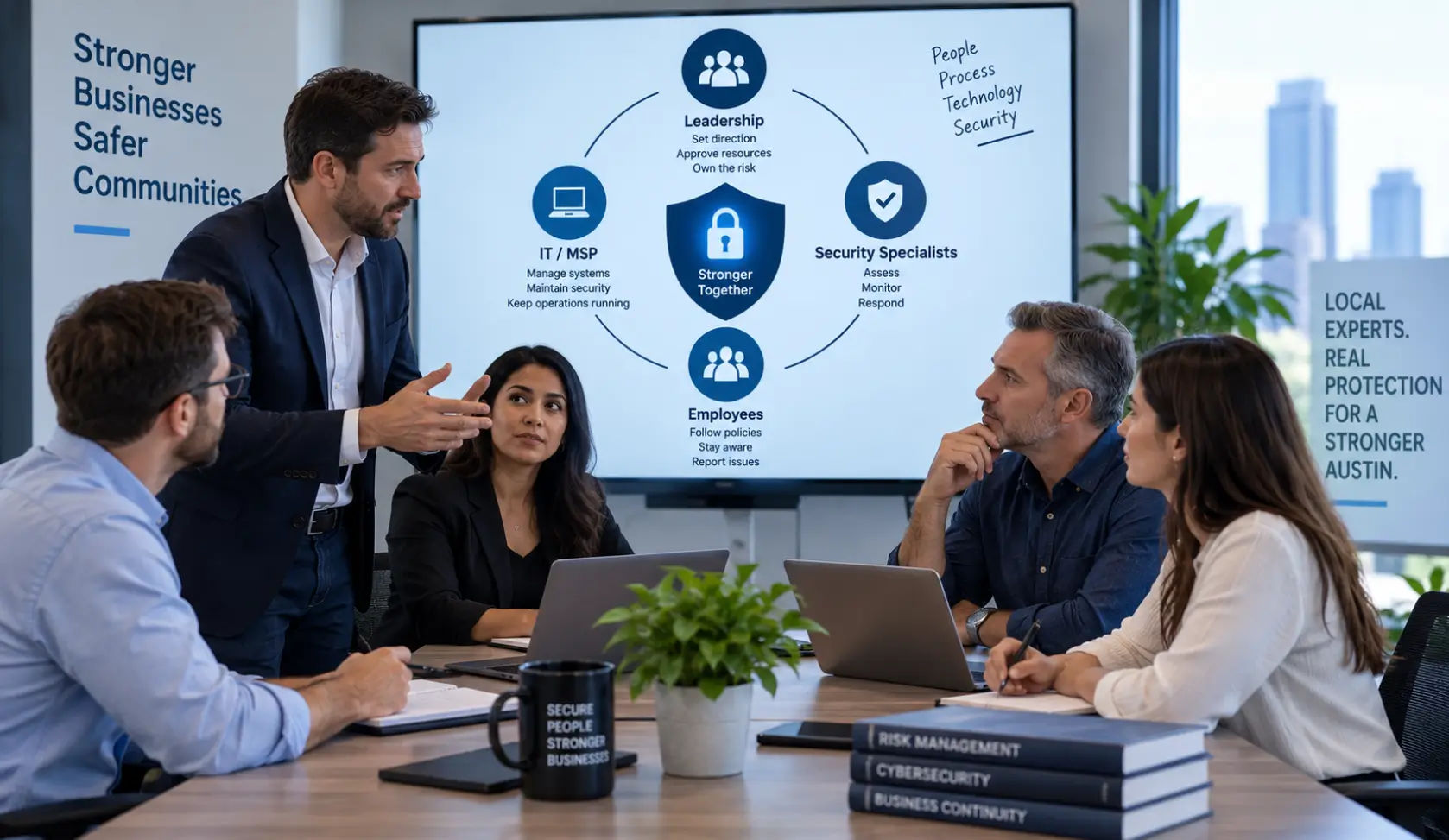
Cybersecurity works better when security responsibilities are clearly divided across the business. The IT administrator or managed service provider may manage systems and technical tasks, but business leadership also has a role in setting priorities, approving resources, and deciding which risks the company is willing to accept.
A practical approach can include:
- Business leadership: Set cybersecurity priorities, approve necessary resources, and understand significant business risks.
- IT administrator or MSP: Manage systems, users, devices, networks, updates, and technical security controls.
- Cybersecurity specialists: Provide security assessments, monitoring, threat detection, incident response, and independent reviews when needed.
- Managers: Make sure employees follow security procedures and report problems.
- Employees: Use security controls correctly, protect their accounts, complete security training, and report suspicious activity.
Clear ownership helps prevent important security tasks from being assumed to be someone else’s responsibility.
Who Should Be Responsible for Cybersecurity Decisions?
Cybersecurity decisions should not depend entirely on one technical employee. Different people may be responsible for different parts of the decision.
For example, an IT administrator may identify a security weakness and recommend a solution. Leadership may then need to decide whether to approve the budget, accept the risk, or change the business process.
This distinction is important because technical responsibility and business risk ownership are not always the same thing.
A documented process should identify:
- Who identifies cybersecurity risks
- Who recommends corrective actions
- Who approves security spending
- Who can accept or decline a known risk
- Who verifies that important controls are working
- Who should be contacted during a security incident
This creates clearer accountability and reduces the chance that an important cybersecurity decision is left with one person.
Cybersecurity Controls Small Businesses Should Review Regularly

Effective cybersecurity is not only about having security tools. Businesses should also review whether those controls are configured correctly and still meet their current needs.
Important areas to review include:
- Multifactor authentication (MFA): Check that important accounts are protected and former users no longer have access.
- User and administrator access: Review privileged accounts and remove unnecessary permissions.
- Endpoint security: Confirm that business computers and other supported devices have appropriate protection.
- Email security: Review protections against phishing, malicious links, and suspicious messages.
- Firewall and network security: Verify that configurations and access rules are reviewed periodically.
- Backup and recovery: Test whether important data and systems can actually be restored.
- Security monitoring: Review relevant security events and alerts instead of relying only on automated notifications.
- Vulnerability management: Identify and address outdated or vulnerable systems.
- Employee security awareness: Keep employees informed about phishing, account security, and reporting procedures.
The exact controls a business needs will depend on its systems, data, industry requirements, and risk exposure.
What Effective Checks and Balances Look Like
Checks and balances should include both people and technology. Small businesses do not necessarily need a large corporate security department, but they do need a repeatable process.
- Document security recommendations, estimated costs, business risks, approvals, and declined projects.
- Review cybersecurity risk with leadership on a regular schedule—not only after an incident.
- Separate routine IT support from independent security validation whenever practical.
- Limit administrative privileges and review privileged accounts.
- Use multifactor authentication, email security, endpoint protection, managed detection and response, and centralized monitoring where appropriate.
- Maintain a funded lifecycle plan for aging servers, unsupported operating systems, storage capacity, and critical infrastructure.
- Test backups and recovery procedures instead of assuming a successful backup report guarantees recovery.
- Document the date, location, duration, and result of every test restore so compliance claims are supported by evidence.
- Create and practice an incident-response plan that defines who makes decisions, contacts vendors, communicates with customers, and coordinates recovery.
- Provide ongoing cybersecurity and social-engineering training for employees and leadership.
Questions Austin Business Leaders Should Ask
- What are our most important systems and data?
- Which cybersecurity recommendations have we postponed or declined?
- Who accepted those risks, and are the decisions documented?
- Who independently verifies our firewall, backups, cloud security, and administrator access?
- Could our business continue operating after ransomware, email compromise, or a major system outage?
- Does our cybersecurity program match the requirements of our customers, contracts, and cyber insurance policy?
How IT Support and Cybersecurity Services Can Work Together
IT support and cybersecurity have related but different responsibilities.
An IT administrator or managed service provider may handle everyday technology needs such as user accounts, computers, networks, software, and technical support. Cybersecurity services can provide additional security-focused capabilities such as risk assessments, security monitoring, vulnerability management, incident response, and independent reviews.
For a small business, these functions can work together rather than placing every responsibility on one person.
A coordinated approach can help the business:
- Identify security gaps
- Review important security controls
- Monitor relevant threats and alerts
- Test backup and recovery procedures
- Improve employee security awareness
- Document cybersecurity decisions
- Establish a clear incident response process
The goal is not to create unnecessary layers of responsibility. It is to make sure important cybersecurity tasks have clear ownership and appropriate oversight.
This section fits BCS naturally because the existing final section already introduces BCS’s cybersecurity services for Austin small businesses.
Local Cybersecurity Help for Small Businesses in Austin, TX
Business Communication Solutions helps small businesses in Austin and surrounding communities evaluate cybersecurity risk, improve checks and balances, and build practical layers of protection. We can work with company leadership, internal IT employees, and existing technology providers to identify gaps without turning the process into a blame game.
Our services can include cybersecurity assessments, managed IT support, network and firewall security, email protection, endpoint security, MDR, SIEM monitoring, backup planning, Microsoft 365 security, employee awareness training, and incident-response preparation.
No provider can promise that a breach will never happen. The goal is to reduce risk, detect problems sooner, respond effectively, and make sure cybersecurity responsibility is shared by the people who make business, budget, and technical decisions.
FAQs
Q: Why is relying on a single IT person a major cybersecurity risk?
A: General IT staff focus primarily on daily availability—troubleshooting printers, deploying PCs, and fixing software. Cybersecurity is a distinct specialization that requires 24/7 threat monitoring, compliance auditing, and threat hunting, which a single administrator cannot realistically handle alone.
Q: What is the CEO’s responsibility in small business cybersecurity?
A: The CEO establishes the organization’s security posture by treating data protection as a business priority, approving policies, and ensuring accountability across all departments rather than treating it solely as an IT issue.
Q: What role does the CFO play in cybersecurity defense?
A: The CFO balances risk mitigation against budgetary constraints, evaluates the financial impact of potential operational downtime, reviews cyber insurance requirements, and ensures critical security initiatives receive necessary funding.
Q: How do general employees contribute to business cybersecurity?
A: Employees serve as the first line of defense. By participating in ongoing security awareness training, following MFA protocols, practicing good password hygiene, and promptly reporting suspicious phishing emails, staff help prevent initial perimeter breaches.
Q: What is co-managed cybersecurity?
A: Co-managed cybersecurity is a hybrid model where an outside Managed Security Service Provider (MSSP) collaborates with your internal IT staff. The internal team continues managing day-to-day operations while the MSSP handles specialized tasks such as 24/7 SOC monitoring, penetration testing, and compliance reporting.
Q: What are security checks and balances in IT administration?
A: Checks and balances involve separating administrative authority and conducting regular independent reviews. Having an outside partner audit firewall rules, user privileges, and backup integrity ensures that human errors or overlooked configurations are identified early.
Q: How often should leadership review cybersecurity risks?
A: Business leaders should review cybersecurity reports quarterly, assessing recent threat metrics, employee training scores, patch compliance, and upcoming technology lifecycle renewals.
Q: What is an incident response plan, and who needs to be on the team?
A: An incident response plan is a documented roadmap detailing actions to take during a breach. The response team must include executive leadership, legal counsel, insurance representatives, IT administrators, and an external incident response partner.
Ready for a practical cybersecurity conversation? Contact Business Communication Solutions to schedule a cybersecurity review for your Austin-area small business. Local on-site help is available.
Related Cybersecurity Reads:
- How Much Does Cybersecurity Cost for a Small Business in Austin, TX?
- Practice Like a Team: Why Cybersecurity Incident Response Is Like Basketball
- It Check and Balance: Why Layered Security and Multiple Admin Oversight Matter
- Why Austin Small Business Leaders Must Take IT More Seriously
- When Do Austin Businesses Realize They Waited Too Long to Fix Their IT?