

Choosing between singlemode and multimode fiber is an important decision when planning a business network, upgrading existing infrastructure, or connecting separate buildings. Both fiber types transmit data using light, but they differ in core size, light propagation, transmission distance, and compatible optical equipment.
The right choice depends on how far data needs to travel, the required network speed, the equipment being used, and the total installation cost. A fiber type that works well inside a data center may not be the most practical option for connecting two separate buildings.
This guide explains the differences between singlemode and multimode fiber, their common applications, and the factors businesses should consider before installation.
What Is Singlemode Fiber?
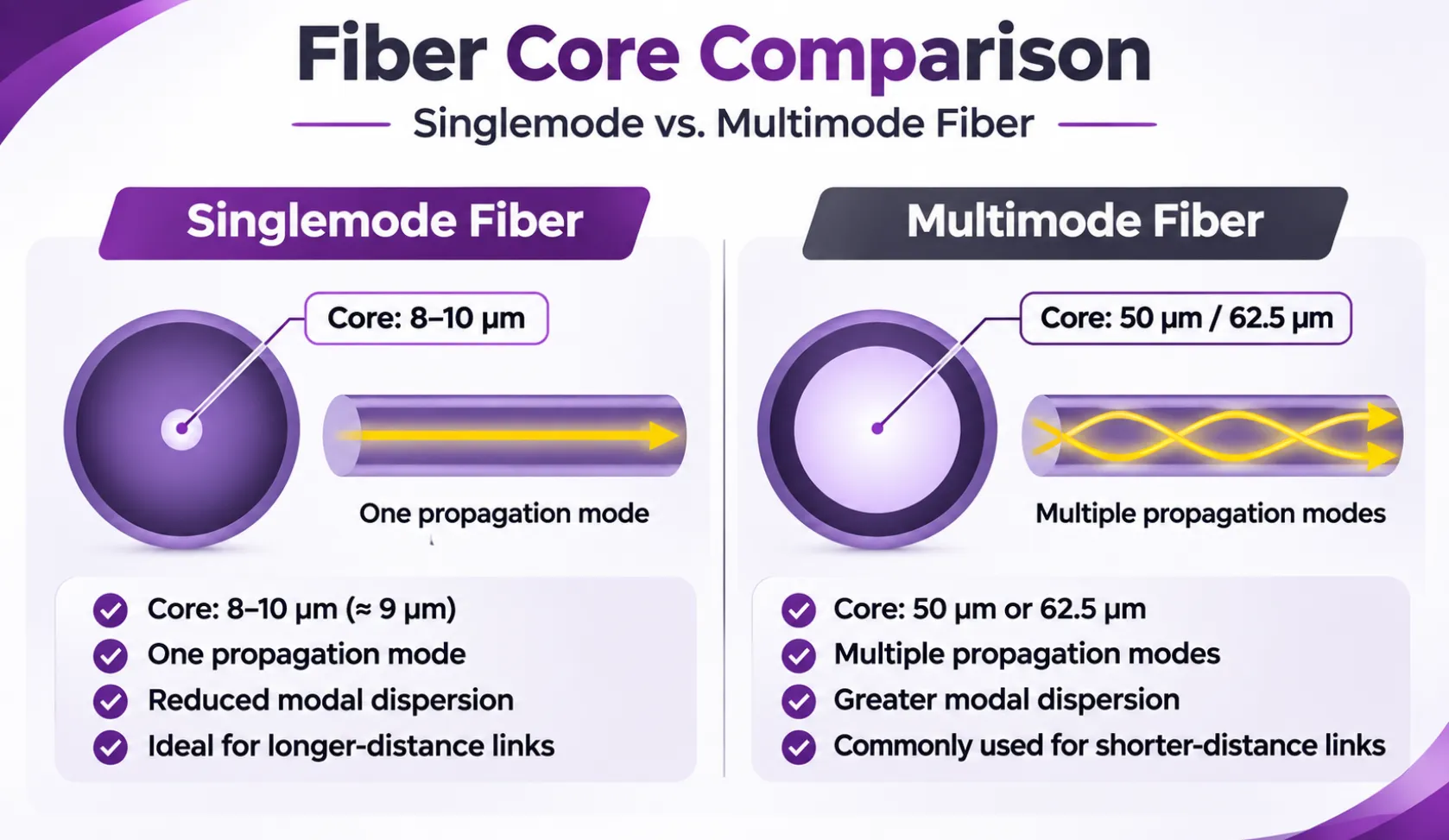
Singlemode fiber (SMF) is an optical fiber designed to carry light through a very small core that supports one propagation mode at a time. Its core is typically around 8–10 micrometers (µm) in diameter, with approximately 9 µm commonly used as the nominal core size.
Because the core is narrow, singlemode fiber significantly reduces modal dispersion. This makes it suitable for transmitting data over longer distances while maintaining signal quality.
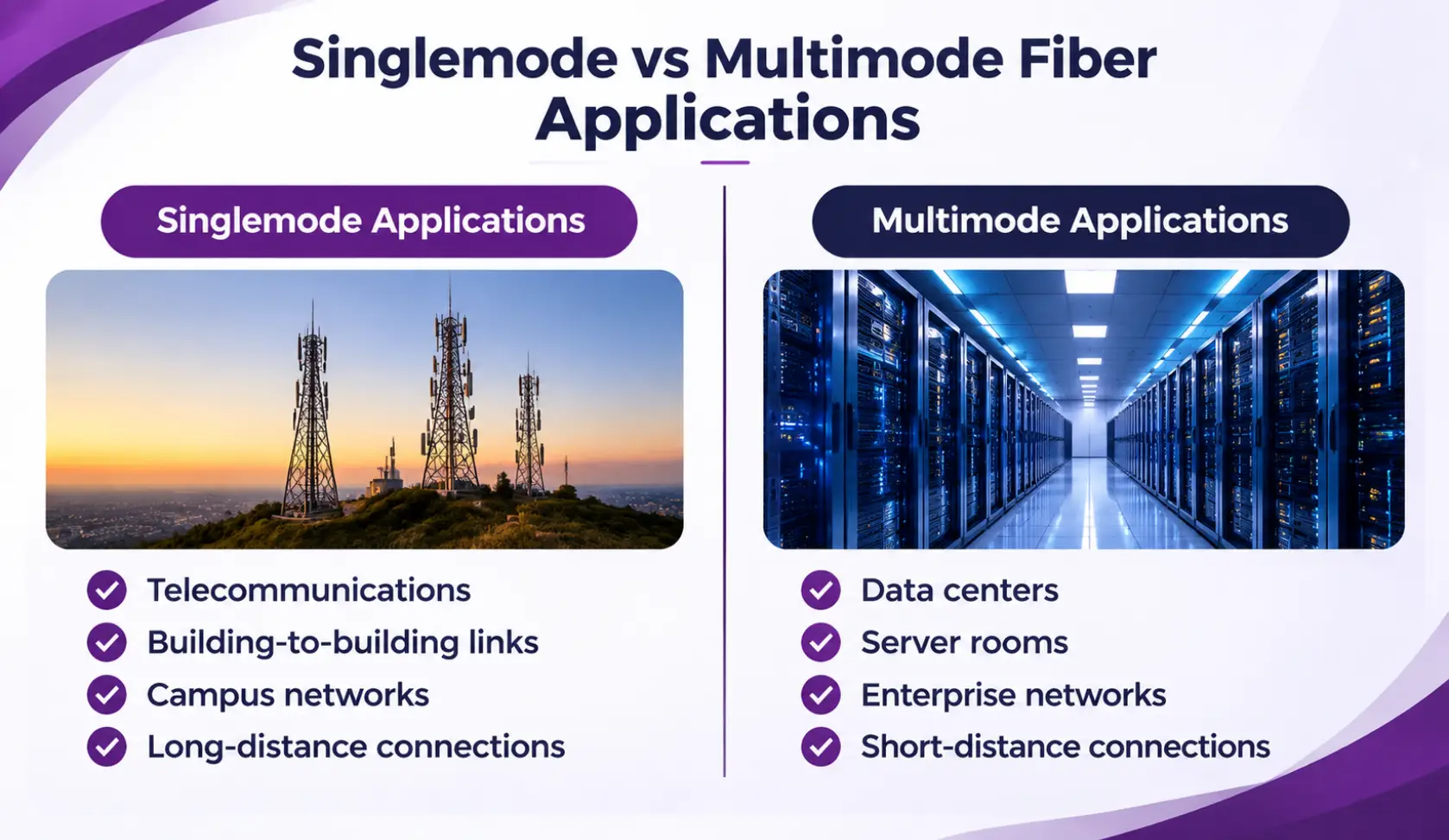
Singlemode systems commonly use laser-based optical transmitters and are widely deployed in telecommunications, campus networks, building-to-building connections, and other applications requiring longer fiber links.
Common Applications of Singlemode Fiber
Businesses and network operators commonly use singlemode fiber for:
- Building-to-building connections: Connecting offices, warehouses, campuses, and separate facilities.
- Long-distance network links: Connecting network locations that are beyond the practical reach of multimode fiber.
- Telecommunications infrastructure: Supporting carrier and service-provider networks.
- Campus networks: Connecting buildings across larger commercial or institutional properties.
- Network expansion: Providing fiber infrastructure for future distance and capacity requirements.
Singlemode is often a practical choice when a business needs longer connections or wants to standardize its infrastructure around singlemode-compatible equipment.
What Is Multimode Fiber?
Multimode fiber (MMF) has a larger core that allows multiple light modes to travel through the fiber simultaneously. Common core sizes include 50 µm and 62.5 µm.
Because light can travel along multiple paths, different light modes may reach the receiving end at slightly different times. This effect is called modal dispersion and can limit the distance over which a multimode link can reliably operate at a given data rate.
Multimode fiber is commonly used for shorter-distance connections, particularly inside buildings, data centers, server rooms, and enterprise networks.
It is often paired with optical transceivers designed for multimode applications, including VCSEL-based equipment.
Common Applications of Multimode Fiber
Multimode fiber is commonly used for:
- Data centers: Connecting servers, storage systems, and network switches within facilities.
- Server rooms: Providing high-speed connections between nearby network devices.
- Enterprise networks: Connecting equipment across floors or within a building.
- Short-distance infrastructure: Supporting fiber connections where link distances are within the selected fiber and transceiver specifications.
- Existing multimode installations: Extending or maintaining infrastructure where compatible multimode equipment is already installed.
The specific multimode grade matters. OM1, OM2, OM3, OM4, and OM5 are not interchangeable performance categories. Each has different characteristics and supported link capabilities.
Singlemode vs. Multimode Fiber: Key Differences
Both fiber types provide high-speed data transmission, but their physical characteristics and equipment requirements differ.
| Comparison Factor | Singlemode Fiber | Multimode Fiber |
|---|---|---|
| Core diameter | Approximately 8–10 µm | Commonly 50 µm or 62.5 µm |
| Light propagation | One propagation mode | Multiple propagation modes |
| Modal dispersion | Greatly reduced | More significant |
| Typical applications | Long-distance links and telecommunications | Shorter-distance enterprise and data center links |
| Common optical sources | Laser-based transmitters | Commonly VCSEL-based transmitters in modern systems |
| Common fiber categories | OS1 and OS2 | OM1, OM2, OM3, OM4, OM5 |
| Distance capability | Supports longer links, depending on optics and fiber specifications | More distance-limited at a given data rate |
| Equipment | Requires singlemode-compatible optics | Requires multimode-compatible optics |
The actual performance of a fiber link depends on the fiber grade, transceiver specifications, data rate, connector quality, and total link design. Always verify compatibility before selecting or installing fiber.
Understanding Fiber Core Size and Light Transmission
One of the most important differences between singlemode and multimode fiber is the size of the glass core.
Singlemode fiber has a much smaller core, typically around 9 µm. It supports one propagation mode, which reduces modal dispersion and makes longer-distance transmission practical.
Multimode fiber has a larger core, commonly 50 µm or 62.5 µm. It allows multiple light modes to travel through the fiber. Because these modes can follow different paths, they may arrive at different times, causing pulse spreading.
This effect limits the distance and data-rate combinations supported by multimode fiber.
The difference in core size also affects how optical signals are coupled into the fiber and which transceivers and connectors are appropriate for the installation.
Transmission Distance and Bandwidth: Which Fiber Performs Better?
Singlemode fiber is generally preferred when a network requires longer transmission distances. Its reduced modal dispersion makes it suitable for applications where connections extend across buildings, campuses, or telecommunications networks.
Multimode fiber is designed for shorter-distance applications. Modern grades such as OM3, OM4, and OM5 support high data rates over distances defined by the applicable fiber and transceiver specifications.
It is important not to assume that one fiber type automatically provides a specific speed or distance in every installation.
For example, the supported reach of a 10 Gigabit link can differ from that of a 40 Gigabit or 100 Gigabit link. The selected transceiver and fiber grade determine the actual supported combination.
Before choosing a cable, verify:
- Required network data rate.
- Total fiber link distance.
- Fiber category and performance rating.
- Optical transceiver specifications.
- Connector and termination requirements.
- Any future network expansion plans.
Singlemode vs. Multimode Fiber: Cost Comparison
Cost is another important factor when selecting fiber optic cabling. However, comparing only the price of the cable does not provide an accurate picture of the total installation cost.
The overall cost may include:
- Fiber optic cable and pathways.
- Optical transceivers at both ends.
- Connectors, patch panels, and enclosures.
- Installation and termination labor.
- Testing and documentation.
- Maintenance and future equipment upgrades.
Multimode systems can offer a lower-cost option for shorter links because compatible optical transceivers may be less expensive in certain applications.
Singlemode systems may require more precise and sometimes more expensive optical components, but they support longer transmission distances.
The most economical solution depends on the complete network design. A lower-cost cable may not be the better choice if it requires additional equipment or cannot support the required link distance.
How to Choose the Right Fiber for Your Business
Before selecting singlemode or multimode fiber, evaluate the actual requirements of your network rather than choosing based on a general assumption that one type is always better.
1. Determine the Required Distance
Start by measuring the complete connection between the two endpoints.
For a short connection within a data center or building, multimode may be suitable if the required data rate is supported.
For connections between separate buildings or across a larger campus, singlemode is often the more practical option.
2. Check Network Speed Requirements
Identify the data rate required by your switches, servers, and other network equipment.
Check the supported speed and maximum reach of the intended transceivers with the selected fiber category. Do not assume that every fiber grade supports every data rate over the same distance.
3. Verify Equipment Compatibility
The fiber type must match the optical transceivers installed at both ends of the connection.
Check the transceiver model, wavelength, connector type, and supported fiber category. A mismatch can prevent a link from operating correctly.
If your business is also upgrading its network infrastructure, consider how fiber connections will integrate with its existing network installation and Wi-Fi infrastructure.
4. Consider Future Expansion
A network installation should account for expected changes in building layouts, connected devices, bandwidth requirements, and additional network locations.
Choosing fiber based only on today’s requirements may create limitations during future upgrades. Evaluate the expected service life and expansion plans before finalizing the design.
5. Include Installation and Testing Requirements
Correct fiber selection is only one part of a reliable connection. Proper termination, connector cleaning, cable routing, bend-radius control, and testing are also important.
Professional fiber optic cabling installation and maintenance can help businesses select compatible components, install the required infrastructure, and verify link performance.
Why Professional Fiber Optic Installation Matters
Fiber optic cables require careful handling during installation. Excessive pulling tension, tight bends, contaminated connectors, and poor termination can affect optical performance.
A properly planned installation should include:
- Selecting the appropriate fiber type and cable construction.
- Confirming compatibility with network equipment.
- Planning pathways and cable protection.
- Maintaining the manufacturer’s minimum bend radius.
- Proper termination or fusion splicing.
- Cleaning and inspecting connector end faces.
- Testing the completed link and documenting results.
Testing methods may include optical loss testing and Optical Time-Domain Reflectometer (OTDR) testing, depending on the link and project requirements.
For businesses planning new construction, office expansions, or network upgrades, professional installation helps identify potential issues before they affect day-to-day connectivity.
Frequently Asked Questions
1. What is the main difference between singlemode and multimode fiber?
The main difference is the core size and the way light travels through the fiber. Singlemode has a smaller core and supports one propagation mode, making it suitable for longer-distance connections. Multimode has a larger core that supports multiple modes and is commonly used for shorter-distance links.
2. Is singlemode fiber better than multimode fiber?
Neither is universally better. Singlemode is generally more suitable for longer distances, while multimode can be a cost-effective choice for shorter links when the required speed and distance are supported by the selected fiber and transceivers.
3. What is the core size of singlemode and multimode fiber?
Singlemode fiber typically has a core diameter of approximately 8–10 µm. Multimode fiber commonly has a 50 µm or 62.5 µm core, depending on the fiber category.
4. Can singlemode and multimode fiber be connected together?
They should not be directly treated as interchangeable. The fiber types have different optical characteristics and generally require compatible transceivers and equipment. Any connection between different fiber types needs an appropriately designed optical solution.
5. Which fiber is commonly used in data centers?
Multimode fiber, particularly OM3 and OM4, is commonly used for shorter-distance data center connections. Singlemode is also used in data centers, especially where longer reach, higher-speed links, or network architecture requirements call for it.
6. Is singlemode fiber more expensive than multimode fiber?
The answer depends on the complete link cost. Singlemode optics can cost more in some configurations, while multimode systems may offer lower transceiver costs for suitable short-distance applications. Cable, equipment, installation, and maintenance should all be considered.
7. How do I know which fiber optic cable my business needs?
Start with the required connection distance, network speed, existing equipment, and future expansion plans. Verify the fiber and transceiver specifications before installation. A fiber optic installation professional can assess the site and help determine a compatible solution.
Need Help Choosing the Right Fiber Optic Cabling?
Selecting between singlemode and multimode fiber depends on your building layout, network equipment, connection distance, and performance requirements.
Business Communication Solutions provides fiber optic cabling installation, termination, fusion splicing, testing, troubleshooting, and repair for businesses in Austin and surrounding communities.
Whether you are connecting network equipment within a building, linking separate facilities, or upgrading existing infrastructure, BCS can help assess your requirements and plan an appropriate fiber optic installation.
Explore BCS Fiber Optic Cabling Installation Services or contact our team to discuss your project.
Related Guides
- Fiber Optics: The Backbone of Modern Networks
- How Fiber Optic Installation Can Transform Your Business Connectivity
- Fiber Optic Termination: Best Practices for Reliable Connections
- Fiber Optic vs. Copper Against Lightning
- Long-Distance Fiber Optic Cabling Through Woods
- Outdoor-Rated Fiber for Commercial Installations
- Low Voltage Wiring Contractor in Austin
- Why Professional Data Cabling Boosts Business Efficiency