

Outdoor fiber optic cables are designed to carry data between buildings, network facilities, campuses and other locations exposed to outdoor environmental conditions. Unlike standard indoor fiber cables, outdoor cables need suitable construction to handle factors such as moisture, temperature changes, sunlight and mechanical stress.
Choosing the right outdoor fiber cable depends on where it will be installed, how it will be routed and how many fibers the network requires. Businesses planning an installation should also consider future network expansion and maintenance requirements.
BCS provides fiber optic cabling installation and maintenance services for business network infrastructure. Understanding the available cable constructions and installation methods can help businesses make better decisions before starting a project.
What Is Outdoor-Rated Fiber Optic Cable?
Outdoor-rated fiber optic cable is designed for use in external environments where cables may experience moisture, sunlight, temperature fluctuations and mechanical forces.
Its construction typically includes optical fibers, protective buffer tubes or other fiber arrangements, strength members and an outer jacket. Additional components may be included depending on the intended application.
Outdoor cable designs vary because different installation environments create different requirements.
For example:
- Aerial installations need cables designed to handle installation tension and ongoing environmental loads.
- Underground duct installations require cables suitable for pulling or blowing through the selected pathway.
- Direct-burial installations require cables specifically designed for direct contact with surrounding soil and underground conditions.
A cable being described as outdoor-rated does not automatically mean it is suitable for every outdoor installation method.
Important Factors to Consider Before Selecting Outdoor Fiber
Before selecting an outdoor fiber optic cable, consider the following factors.
1. Required Fiber Count
Determine how many optical fibers the network needs.
The required fiber count depends on the number of connections, network equipment, communication requirements and potential future expansion.
Installing additional fiber capacity may be worth considering during the initial project because adding another cable later can require additional installation work.
However, the appropriate fiber count should be based on the actual network design rather than an arbitrary number.
2. Installation Location
Identify where the cable will be installed.
Common outdoor installation environments include:
- Underground ducts and conduits
- Direct-burial routes
- Utility poles and aerial pathways
- Outdoor building connections
- Campus network routes
Each application may require a different cable design. Always check the manufacturer’s documentation to confirm that the selected cable is approved for the intended installation.
3. Environmental Conditions
Outdoor cables may be exposed to:
- Moisture and water exposure
- Temperature fluctuations
- Ultraviolet (UV) radiation
- Mechanical pressure
- Rodent activity
- Installation and pulling forces
The cable jacket, water-blocking construction and mechanical protection should be selected according to the conditions expected along the route.
4. Future Network Requirements
Consider whether the network may need additional connections or higher fiber capacity in the future.
Planning for expansion during the initial installation can help reduce the need for additional cable routes and installation work later.
Common Types of Outdoor Fiber Optic Cable
Outdoor fiber cables are available in different constructions. The following are common designs used in outside plant (OSP) applications.
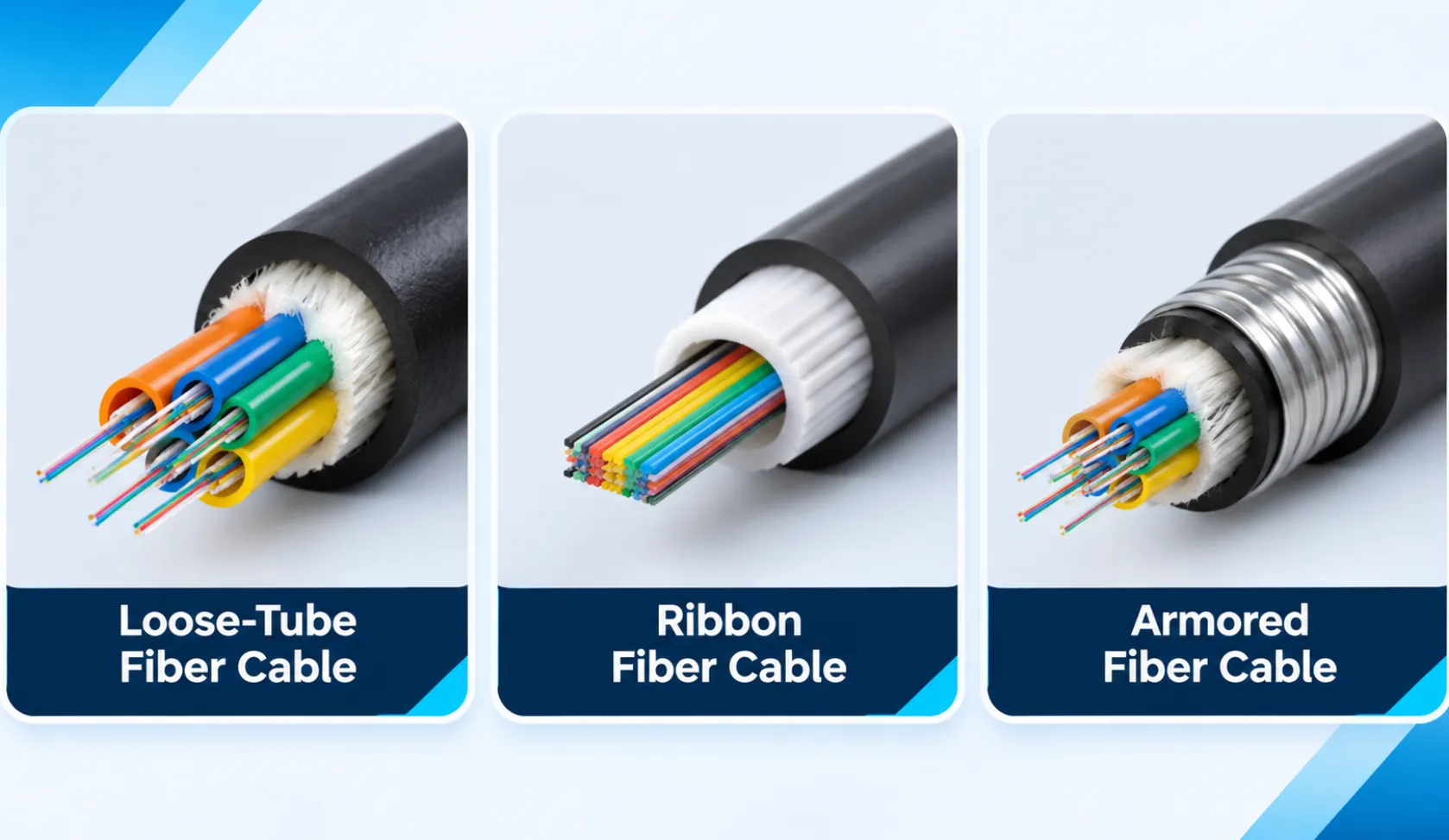
1. Loose-Tube Fiber Optic Cable
Loose-tube fiber cable contains optical fibers placed inside protective buffer tubes. The tubes provide space around the fibers and help protect them from environmental and mechanical influences.
Loose-tube designs are widely used in outdoor fiber installations, including duct and certain aerial applications.
Common characteristics:
- Fibers are organized inside buffer tubes.
- Available in different fiber counts.
- Can use gel-filled or dry water-blocking designs.
- Suitable cable variants are available for different outdoor applications.
Loose-tube cable is commonly considered for outside plant networks where fiber protection and installation requirements must be addressed.
2. Ribbon Fiber Optic Cable
Ribbon fiber cable arranges multiple optical fibers in flat ribbons rather than placing individual fibers separately inside loose tubes.
This construction can support high fiber counts and may be useful in network projects that require a large number of fiber connections.
Common characteristics:
- Fibers are arranged in ribbon units.
- Supports high-density cable designs.
- Can support mass fusion splicing when the fiber and splice equipment are compatible.
- Available in outdoor cable constructions.
Ribbon fiber may be suitable for larger network projects where fiber count and splicing requirements are important considerations.
3. Armored Fiber Optic Cable
Armored fiber optic cable includes an additional protective layer designed to improve mechanical protection.
Depending on the cable design, armor may help protect against crushing, physical damage and rodent penetration.
Armored cable is used in applications where additional mechanical protection is required. Some armored cable designs are suitable for direct burial, but this must be confirmed through the manufacturer’s specifications.
Common characteristics:
- Additional mechanical protection.
- Available in different cable constructions.
- May help resist rodent damage.
- Can be designed for particular underground or outdoor applications.
Armor does not automatically make every cable suitable for direct burial. The complete cable must be rated for the intended installation.
4. Aerial Fiber Optic Cable
Aerial fiber optic cable is installed above ground, commonly between utility poles or other supporting structures.
These cables must be designed to handle the mechanical loads associated with their installation and operating environment, including cable weight and applicable wind or ice loads.
Two common aerial cable arrangements include:
Messenger-supported cable: The fiber cable is attached to a separate supporting messenger or supplied in a figure-eight construction with an integrated messenger.
All-Dielectric Self-Supporting (ADSS) cable: ADSS cable is designed to support itself without a separate metallic messenger. It uses nonconductive strength components and requires appropriate supporting hardware.
The choice depends on the pole infrastructure, route design, electrical environment and cable specifications.
5. Direct-Burial Fiber Optic Cable
Direct-burial fiber optic cable is designed to be installed underground without being placed inside a separate conduit.
These cables require suitable construction to withstand the conditions associated with direct burial, including soil pressure, moisture exposure and potential mechanical damage.
Armored construction is commonly used for direct-burial applications, although the exact design depends on the manufacturer’s product.
Before selecting direct-burial cable, check:
- Whether the cable is specifically rated for direct burial.
- Its water-blocking construction.
- Its mechanical protection.
- The expected soil and installation conditions.
- Applicable installation requirements.
An outdoor-rated cable should not be assumed suitable for direct burial unless its documentation explicitly supports that application.
6. Duct Fiber Optic Cable
Duct fiber optic cable is installed inside an underground duct, conduit or innerduct.
The duct provides a pathway for the cable and can help protect it from direct exposure to surrounding soil and other external conditions.
Depending on the project, cables may be pulled or blown into the duct using suitable installation equipment.
The cable must be designed for the selected installation method and should meet the applicable pulling or blowing requirements.
Gel-Filled vs. Gel-Free Outdoor Fiber Cable
Outdoor fiber cables may use different water-blocking technologies to help limit moisture movement inside the cable.
Two common approaches are gel-filled and dry water-blocking constructions.
Gel-Filled Fiber Cable
Traditional gel-filled cables use water-blocking gel within parts of the cable construction.
The gel helps limit water movement if moisture enters the cable.
One consideration during installation is that gel may need to be cleaned from fibers during cable preparation and splicing.
Gel-Free Fiber Cable
Gel-free or dry water-blocking cables use materials such as water-swellable tapes, yarns or other components instead of traditional filling gel.
These materials are designed to limit water movement through the cable.
Key difference: Gel-free construction can reduce the cleaning work associated with gel during cable preparation. However, both designs must be evaluated according to their product specifications and intended applications.
Neither term should be interpreted as meaning that a cable is completely waterproof under every condition.
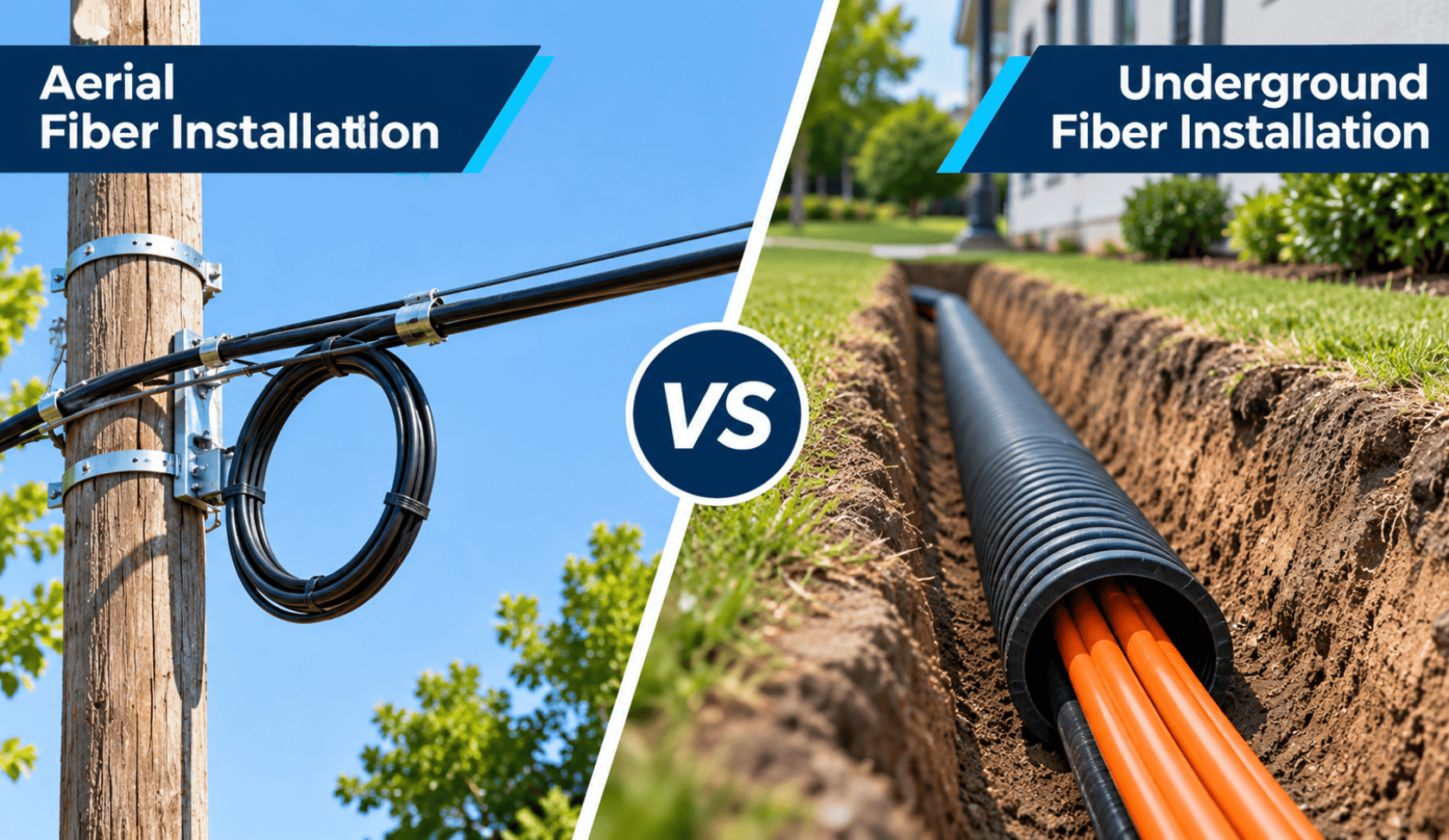
Aerial vs. Underground Fiber Installation
The installation method affects the cable construction, supporting equipment and planning requirements.
| Factor | Aerial Fiber | Underground Fiber |
|---|---|---|
| Installation location | Poles or supporting structures | Underground routes |
| Common cable options | Messenger-supported or ADSS | Duct or direct-burial cable |
| Main considerations | Tension, wind, ice and support hardware | Moisture, soil conditions and mechanical protection |
| Installation requirements | Suitable poles, hardware and permissions | Ducts, trenches or other approved pathways |
| Maintenance access | Access to aerial routes and poles | Access through handholes, manholes or other facilities |
Neither method is automatically better for every project.
Aerial installation may be considered where suitable pole infrastructure exists. Underground installation may be preferred where the route design, site conditions or project requirements support it.
The decision should consider installation costs, permissions, environmental exposure, accessibility and long-term maintenance.
How to Select the Right Outdoor Fiber Optic Cable
Selecting outdoor fiber cable requires evaluating the complete installation rather than choosing a product based only on its name.
Use the following checklist:
- Define the installation route: Identify whether the cable will be aerial, underground in a duct, or directly buried.
- Determine the fiber count: Calculate the required number of fibers and consider future expansion.
- Review environmental conditions: Evaluate moisture, temperature, sunlight and potential physical damage.
- Select the cable construction: Compare loose-tube, ribbon, armored and other suitable designs.
- Check manufacturer specifications: Confirm the cable’s approved installation applications and performance ratings.
- Review installation requirements: Check pulling tension, bend radius, supporting hardware and other relevant instructions.
- Plan maintenance and expansion: Consider access to cable routes, splice locations and future network requirements.
If the project involves multiple buildings or long outside plant routes, proper planning is especially important.
Common Mistakes to Avoid When Choosing Outdoor Fiber
Some selection mistakes can create unnecessary installation and maintenance problems.
- Assuming every outdoor cable supports direct burial: Direct-burial suitability must be confirmed through product documentation.
- Ignoring environmental exposure: Moisture, sunlight and temperature conditions can affect cable selection.
- Choosing an insufficient fiber count: Failing to consider future requirements may result in additional installation work.
- Overlooking mechanical protection: Some routes may require additional protection against physical damage.
- Confusing cable construction with installation method: Loose-tube and ribbon describe cable designs, while aerial, duct and direct burial describe applications.
- Ignoring manufacturer installation instructions: Pulling tension, bend radius and other limits must be followed to avoid cable damage.
Frequently Asked Questions
1. What is the difference between indoor and outdoor fiber optic cable?
Outdoor fiber cables are designed for external environmental conditions such as moisture, temperature changes and sunlight. Indoor cables are designed for building environments and must meet the applicable indoor installation requirements.
2. Which fiber optic cable is suitable for outdoor installation?
The suitable cable depends on the installation method. Loose-tube and ribbon designs are available for outdoor applications, while aerial, duct and direct-burial installations require cable variants specifically designed for those conditions.
3. What is armored fiber optic cable used for?
Armored fiber cable provides additional mechanical protection. Depending on its construction, it may be used in applications where additional resistance to physical damage or rodent penetration is required.
4. Can outdoor fiber optic cable be buried directly underground?
Only if the specific cable is designed and rated for direct burial. Not every outdoor-rated fiber cable is suitable for installation directly in soil.
5. What is the difference between loose-tube and ribbon fiber cable?
Loose-tube cable places individual fibers inside protective buffer tubes. Ribbon cable arranges multiple fibers in flat ribbon units. Both are available in outdoor constructions, but their fiber organization and splicing methods differ.
6. What is ADSS fiber optic cable?
ADSS stands for All-Dielectric Self-Supporting. It is an aerial fiber optic cable designed to support itself without a separate metallic messenger.
7. Is gel-free fiber cable better than gel-filled fiber cable?
Neither is universally better. Gel-free designs can reduce cleaning requirements during cable preparation, while the right choice depends on the cable’s specifications, application and installation requirements.
8. How do I choose the correct fiber count for an outdoor network?
Consider the number of required connections, network design, expected expansion and available equipment. A qualified network designer or installation provider can help determine the appropriate fiber count.
Plan Your Outdoor Fiber Optic Installation with BCS
Outdoor fiber optic installations require careful consideration of cable construction, environmental conditions, installation methods and future network requirements.
Choosing the right cable at the planning stage can help businesses build network infrastructure that meets their connectivity needs and installation conditions.
Business Communication Solutions (BCS) provides fiber optic cabling installation and maintenance services. If your business is planning an outdoor fiber optic project, contact BCS to discuss the installation requirements and available cabling options.
Related Guides
- How Fiber Optic Installation Can Transform Your Business Connectivity
- Google Fiber Is Coming to Round Rock
- Professional Voice and Data Cabling Services
- Why Professional Data Cabling Boosts Business Efficiency
- Low Voltage Wiring Solutions for Businesses
- New Underground Pipe for Network Infrastructure
- Elevate Your Connectivity with Wireless Networking Services
- Managed IT Services: The Complete Austin Guide