

Cybersecurity is no longer a concern solely for large enterprises.
Today, businesses of all sizes and types, from local retailers to healthcare practitioners to law firms, are at risk.
As technologies advance and more and more companies start adopting cloud technologies, remote workforces, and become heavily dependent on digital operations, they have become a much easier target for cybercriminals. This has moved cybersecurity solutions for businesses from a safety precaution to a modern necessity.
Cybercriminals today use advanced tactics to exploit even the smallest vulnerabilities. Any small breach can lead to operational downtime, financial losses, damaged customer trust, legal consequences, and costly compliance violations. Unfortunately, most companies fail to realise the importance of cybersecurity until they have already suffered an attack.
Modern businesses require a focus more on prevention than cure through proactive, layered protection combining technology, continuous monitoring, employee education, and expert support that help reduce cyber risk before it becomes a crisis.
What are Cybersecurity Solutions for Business?
Cybersecurity solutions for business refer to essential tools and services designed to protect an organisation’s networks, systems, devices, applications and sensitive data from cyber threats.
Businesses nowadays, rather than relying on a single security tool, require a comprehensive layered approach to protection that brings security across every part of their IT environment.
The most effective business cybersecurity solutions work together to prevent attacks, detect suspicious activity in real time, respond quickly to incidents, and minimize business disruption. This strategy helps organizations reduce risk while maintaining productivity, customer confidence, and regulatory compliance.
Common Cyber Threats Most Businesses Face
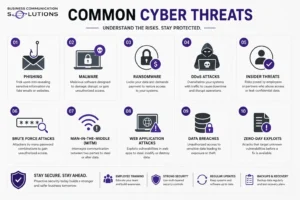
Understanding modern cyberattacks is the first step towards building a strong defense against them. While the ways of attacks and methods continue to evolve, most attacks exploit the same vulnerabilities. Knowing them can help you pick the right professional cybersecurity services against them and identify, prevent, and respond to them appropriately. Some of the most common cyberattacks include:
- Ransomware
- Phishing emails
- Business Email Compromise (BEC)
- Insider Threats
- Credential Theft
- Malware
- Cloud Security Risks
- Zero-Day Attacks
Core components of a strong cybersecurity program
A good cybersecurity program is a collaboration of various strong core components that come together to achieve complete security. These include:
Network Protection
A secure network is the backbone of any business operations. Ensuring its security requires implementing firewalls, intrusion prevention systems, network segmentation, and continuous traffic monitoring to block any unauthorized access and detect malicious activity before it spreads.
Remember, a protected network is vital to ensure your employees, customers, and business-critical applications can safely operate uninterrupted.
Endpoint Security
Every server, be it laptop, desktop, smartphone, or tablet, that is connected to your network can be a potential entry point for attackers. Endpoint security protects these devices with advanced antivirus software, behavioral analysis, Endpoint Detection and Response (EDR), and automated threat containment.
Email Security
Even today, email remains one of the most common and easiest attack vectors for cybercriminals. Even the most tech-aware people can be tricked into revealing sensitive information or installing harmful malware through Phishing emails, malicious attachments, fake invoices, and impersonation attempts.
This is why comprehensive email security filters are a must for every business to filter out suspicious messages, block dangerous attachments, scans URLs before they reach your or your employees’ inbox.
Identity and Access Protection
Unauthorised access has always been the leading cause of data breaches. A strong identity protection ensures that only authorised users can access sensitive systems and information through various measures, including multi-factor authentication (MFA), Single Sign-On (SSO), role-based access controls, identity monitoring, strong password policies, etc.
Cloud Security
As businesses continue to migrate applications and data to cloud platforms such as Microsoft 365 and Azure, cloud storage protection is needed now more than ever. Businesses today require a well-designed cloud security strategy that secures cloud storage, user permissions, workloads, backups, collaboration platforms and overall business data regardless of where employees work.
Advanced Firewalls
Old firewalls that blocked unwanted traffic are simply not enough anymore. Next-generation firewalls serve as the first line of defense against external attacks by inspecting application traffic, identifying advanced threats, enforcing security policies, and preventing unauthorized access to business networks.
Threat Detection and Continuous Monitoring
Cybercriminals don’t follow businesses’ clock; they can attack at any point in time. Hence, continuous monitoring and threat detection are a must. Continuous monitoring allows security professionals to identify suspicious behavior, investigate unusual network activity, and respond before a threat causes significant damage while significantly reducing the time attackers can go undetected within a network.
Employee Security Training
Prevention is always better than cure, and technology alone cannot stop every cyberattack. This is why businesses need to ensure that their staff stays informed and well-trained to protect themselves and the business against such cyberattacks. Regular employee training about various cyberattacks, including phishing emails, fake login pages, suspicious attachments, unsafe browsing habits, passwords, etc can tremendously help in keeping your business safe against such cyberattacks
Backup and Disaster Recovery
Understanding that, despite all security precautions, unexpected events can always happen is just as important. This is why businesses must prepare for such situations in advance with reliable backup and disaster recovery solutions. An effective disaster recovery strategy includes automated backups, secure off-site storage, cloud-based recovery, and regular recovery testing and ensures that all your critical data can be restored quickly, minimizing downtime and helping organizations resume normal operations faster.
Compliance and Risk Management
Many industries must comply with regulations governing data privacy and cybersecurity. Healthcare organizations, financial institutions, legal firms, and government contractors often face strict compliance requirements.
Comprehensive cybersecurity programs help organizations meet standards such as HIPAA, PCI DSS, NIST, and other regulatory frameworks by implementing appropriate safeguards, documentation, and ongoing security assessments.
Importance of Layered Cybersecurity Approach for Businesses

As technology continues to evolve, so does the severity and methods of cyberattacks. No single security measure can protect against all cyberattack threats. A layered cybersecurity approach allows businesses to deploy multiple layers of protection that work together. This approach includes:
- Network security
- Endpoint protection
- Email filtering
- Identity management
- Cloud security
- Continuous monitoring
- Security awareness training
- Backup and disaster recovery
- Compliance support
Together, these layers create a resilient security framework that protects your business from a wide range of cyber threats while minimizing downtime and operational disruption.
At BCS Voice & Data, we design customized cybersecurity strategies that combine these technologies into a seamless, proactive defense. Instead of relying on disconnected tools, businesses benefit from integrated security solutions tailored to their size, industry, compliance requirements, and long-term growth goals.
Why Choose BCS Cybersecurity Solutions for Business

Choosing the right cybersecurity solutions for business provider isn’t simply about finding someone with the right technology. Rather, it is about finding a partner that understands your business, its unique needs, anticipates emerging threats and provides protection and dependable support.
That’s where we come in.
We at BCS combine decades of IT expertise with a proactive approach to cybersecurity, helping organizations build resilient, secure, and future-ready IT environments.
We help businesses of all sizes, from small businesses to growing enterprises with complex requirements, and deliver cybersecurity solutions tailored to their unique needs, earning the trust of businesses throughout Austin, TX.
As your cybersecurity solutions for business partner, we offer:
- Decades of technology experience
- Proactive Security, Not Reactive Fixes
- Customized Security Strategies
- Managed Cybersecurity Services
- Rapid Response When It Matters Most
- Enterprise-Grade Security Technology
- Compliance Support Across Regulated Industries
- Scalable Solutions That Grow With Your Business
- A Trusted Long-Term Technology Partner
Whether you’re a growing small business, a healthcare provider, a law firm, a manufacturer, or a multi-location enterprise, we at BCS offer cybersecurity solutions for small businesses and large enterprises and build resilient, future-ready security programs tailored to your unique needs.
Our experienced team delivers managed cybersecurity services, proactive threat monitoring, compliance support, and scalable security solutions designed to protect your people, technology, and data.
If you’re ready to strengthen your organization’s cybersecurity posture, contact BCS today to schedule a cybersecurity assessment or consultation. We’ll help you identify potential risks, implement the right security solutions, and build a strategy that keeps your business protected today and prepared for whatever comes next.
Frequently Asked Questions
1. What are cybersecurity solutions for business?
Cybersecurity solutions for business refer to essential tools and services designed to protect an organisation’s networks, systems, devices, applications and sensitive data from cyber threats.
2. Is cybersecurity worth it for small businesses?
Yes. Small businesses are increasingly targeted because attackers often view them as easier targets. Investing in the best cybersecurity solutions for small businesses 2026 is far less expensive than recovering from a ransomware attack, data breach, or prolonged operational disruption.
3. How much do business cybersecurity services cost?
The cost of cybersecurity services varies depending on business’s size, number of users, regulatory requirements, factors such as company size, number of users, regulatory requirements, existing infrastructure, and the level of protection required.
4. Can cybersecurity prevent ransomware?
While no cybersecurity solutions for business can guarantee complete protection, a layered cybersecurity strategy greatly reduces the risk of ransomware through combining endpoint protection, email security, patch management, continuous monitoring, employee training, and secure backups.
5. Does BCS Voice & Data provide managed cybersecurity services?
Yes. BCS Voice & Data provides comprehensive managed cybersecurity services that include proactive monitoring, threat detection, endpoint protection, firewall management, cloud security, backup and disaster recovery, compliance support, and ongoing security management tailored to each client’s needs.
6. Can BCS help with compliance?
Absolutely. BCS works with organizations across regulated industries to strengthen security controls and support compliance with standards such as HIPAA, PCI DSS, NIST, and other applicable regulatory frameworks.