

The wireless access point must be connected to the network, which is why the need for data cabling arises. By creating a wired backbone, it is possible to ensure a more stablA reliable network begins with the right infrastructure, including the proper cabling. While it is true that modern advancements make it easier to connect wirelessly, cabling is necessary for any business, home, security system, phones, access points, and more.
Whether your need is new office construction, retrofitting, multi-building connections, camera systems, or residential improvements, professional data cabling installation can help.
A properly installed system can reduce downtime, simplify troubleshooting, increase network speeds, and provide an overall organized infrastructure.
Business Communication Solutions (BCS) specializes in voice, data, fiber, and security camera cabling installation for residential and commercial customers in the Austin area and is proud to offer its services to those seeking professional low-voltage cabling solutions.
In this guide, we will go over the different types of cabling, the installation process, materials, and when you may need professional network cabling installation services.
What Is Data Cabling Installation?
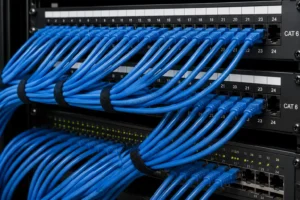
Data cabling installation typically involves the professional installation of network cable, voice data cable, fiber optic cable, and other low-voltage cabling.
Some of the components of a data cabling installation include:
- Ethernet network cable
- Cat 5e or Cat 6 cabling
- Fiber cable
- Patch panels
- Data jacks
- Network racks
- Network switches
- Cable management
- Conduit
- Connectors and terminations
- Testing and labeling
Most people think of connecting a cable from Point A to Point B, which is only a small part of the overall cabling installation.
A professional data cabling installation will ensure that your network infrastructure is up to standard and can support your current and future technologies.
BCS offers voice, data, coaxial, fiber, security camera, and other low-voltage cabling installation solutions for residential and commercial customers.
Why Professional Data Cabling Matters
While your internet service provider may handle the connection to the internet, the cabling within your structure determines how that connection is distributed.
Poorly installed or low-quality cable, incorrect terminations, long runs, and more can introduce unnecessary complications.
Professional network data cabling installation can help improve reliability, speeds, ease of troubleshooting, organization, and future-proofing. Some of the most common reasons to invest in professional network cabling installation include:
Improved Network Reliability
A properly installed network cabling system can maximize reliability, providing an organized and dependable connection from your switches, modems, routers, access points, phones, computers, cameras, and other devices.
Increased Speeds and Performance
The right data cabling solution can allow you to take advantage of the speed and performance of your equipment and internet service.
Reduced Downtime and Troubleshooting Costs
Properly terminated, organized, and labeled cabling makes it much easier to identify and resolve issues.
Improved Organization
A professional data cabling installation can use patch panels, racks, cable management, and other tools to provide a clean and organized infrastructure.
Future-Proofing Your Infrastructure
A professional network cabling installation will look at your future needs in terms of additional workstations, access points, cameras, and more.
Types of Data and Communication Cabling
Not all data and communication cabling is the same, and different structures have different requirements.
Here is an overview of the primary cabling types and considerations.
Ethernet Cabling & Power over Ethernet (PoE) Services

Wiring for Ethernet connections is a reliable way to get wired connections for your network equipment. In addition, PoE can provide power and data to your devices through Ethernet cables.
Ethernet and PoE can be used for:
- Computers and workstations
- VoIP phones
- Wireless access points
- IP security cameras
- Access control
- Switches and other equipment
Professional installation of Ethernet and PoE will allow you to have properly routed, terminated, labeled, and tested cables that will provide reliable connections and a nice-looking network infrastructure.
Voice Data Cabling Installation
Many businesses use the same infrastructure for voice and data, allowing a structured cabling solution to support phones, computers, printers, access points, data devices, and more.
VoIP phone cabling, computer network cabling, and other low-voltage voice data cabling solutions can be used for:
- VoIP phones
- Computer workstations
- Network printers
- Wireless access points
- Data devices
- Other communication equipment
BCS has been providing voice and data cabling installation solutions since its inception and is committed to serving commercial and residential customers throughout the Austin area.
If you are planning to transition from traditional phone systems to VoIP, it is also important to ensure your network infrastructure supports your phone system.
Fiber Optic Installation

While copper cabling is great for most applications, it is not the only option.
Fiber optic installation can be used to connect switches, network rooms, buildings, and more, using light to transmit information rather than electricity.
Fiber can be a good solution when:
- Connecting to another building
- Extending network cabling beyond standard distances
- Connecting switches within a building or across buildings
- Reaching a long distance beyond standard Ethernet limits
- Connecting to another location to extend the internet connection
- Creating a high-speed backbone
BCS offers fiber optic installation, termination, testing, troubleshooting, splicing, repairs, moves/adds(changes), and more.
There are different types of fiber optic cabling, including single-mode and multi-mode, and the choice between the two depends on the application, distance, equipment, and more.
As a general rule, many internet service providers use single-mode fiber, while OM3, OM4, and OM5 multi-mode can be appropriate for certain applications.
Due to the nature of fiber optics, professional installation is often necessary.
Security Camera Cable Installation

Similar to other network-connected devices, security cameras require cable to function properly.
Security camera cable typically carries data, and some systems also carry power, using the network connection to support the camera.
Some security camera systems use standard Ethernet cabling and can benefit from PoE network switches, allowing switches to provide network connectivity and power to the camera.
Planning the security camera cabling is particularly important in the following cases:
- Outdoor cameras
- Long cable runs
- High resolution
- Moisture
- Parking lots or other large areas
- Warehouses or commercial properties
BCS provides security camera cabling installation solutions and has experience with camera cable issues, including corrosion and damaged or broken connections.
Routing the camera cable is particularly important in some cases, especially for outdoor applications.
Access Control Cabling Installation

Access control systems allow businesses and other organizations to limit entry to specific areas.
Depending on the solution, access control cabling may be used for:
- Card readers
- Keypad readers
- Door controllers
- Electronic locks
- Request-to-exit devices
- Door position sensors
- Access control panels
- Network connections
Access control cabling usually needs to be planned in advance, as the solution often includes both electrical and low-voltage infrastructure.
BCS provides access control solutions and cabling as part of its low-voltage infrastructure services.
When combined with other low-voltage systems such as security cameras, access control can be installed at the same time with benefits.
Paging Horn Installation

Paging horn installation can help you establish a reliable way of communication by providing clear speech to large areas both indoors and outdoors. These systems can be used in commercial and industrial facilities where it is necessary to speak to a large audience.
Paging horns can be installed in:
- Warehouses and industrial facilities
- Schools and commercial buildings
- Churches and community facilities
- Parking lots and other outdoor areas
- Large offices and other facilities
Professional paging horn installation will help you ensure that your speakers are properly placed and provide reliable sound to the areas they are supposed to cover.
Conduit Installation
In some cases, simple cable installation is not enough, and additional protection is required.
This is when conduit installation can be useful, and there are several reasons why conduit is necessary. Some of these reasons include:
- Outdoor installation
- Underground runs
- Connecting different buildings
- Protection from damage
- Commercial applications
- Environmental concerns
BCS has worked on several projects that require underground data cable installation between buildings.
For these types of projects, a conduit can provide the necessary protection for data cabling and fiber optic runs, particularly when distances exceed standard Ethernet limits.
Conduit is also important in some cases to allow for future maintenance and other changes.
What Does a Professional Network Cabling Installation Include?
A professional network cabling installation is not as simple as finding a place to plug in the cable.
Here is an overview of some of the most important steps, including planning, cable runs, terminations, labeling, and more.
Site Survey and Planning
The most important part of any network cabling installation is the planning, including the site survey. A professional installer will analyze the property and determine the requirements, including:
- Number of users
- Number of workstations
- Number of data drops
- Wireless access points
- Cameras
- Phones
- Server room or network closet
- Location of cable runs
- Distance between buildings
- Existing infrastructure
- Future requirements
BCS will conduct a survey and can provide an estimate based on the requirements.
Choosing the Appropriate Cable
Once planning is complete, the next step is to choose the appropriate cable type, which may include:
- Cat 5e
- Cat 6
- Fiber optic cable
- Coaxial
- Low-voltage cable
Choosing the appropriate cable type depends on the application, distance, equipment, and future requirements.
Planning the Cable Route
One of the most important aspects of any cabling installation is route planning, which determines where exactly the cable will be located.
A professional installer will make sure that the route is appropriate and takes advantage of existing infrastructure such as attics, walls, cable trays, and more.
- Running the Cable
- Once the route has been determined, the cable can be run, which may include:
- Interior walls
- Ceiling space or attics
- Cable trays
- Conduit
- Underground
Depending on the project, many professional installers will handle exterior and underground cable runs.
Making the Terminations
Once the cable reaches its destination, a professional installer will make the termination, which will depend on the application. Some common terminations include:
- Data jacks
- Patch panels
- Connectors
- Fiber enclosures
- Patch cords
- Network switches
Proper terminations are critical for the performance of the network cable. Poorly made terminations can lead to poor connectivity, even with the right cable.
Labeling and Organization
Every cable should be labeled and organized, which is particularly important for larger installations, including commercial properties or homes with multiple data drops.
Proper organization and labeling help identify the cable and its purpose. In addition, proper cable management makes it much easier to work on the infrastructure in the future.
Testing
Once the cabling has been installed, it must be tested to ensure there are no issues. Fiber optic cabling may require additional testing and specialized equipment, including laser testing.
Testing is critical, particularly for copper cabling, to ensure there are no wiring or connectivity issues before the network goes live.
Structured Cabling Vs. Basic Network Cable Installation
When it comes to network cabling, some jobs are more involved than others.
A basic network cable installation might include simply connecting one or two Ethernet cables.
At the same time, a structured cabling installation is more involved and may include multiple data drops, patch panels, racks, switches, network rooms, VoIP phones, cameras, and much more.
For example, BCS can handle a structured network cabling installation that includes 48-port patch panels, Cat 6 cabling, testing, labeling, racks, and switches.
Structured cabling is typically appropriate for larger commercial properties or homes with complex requirements. It is particularly useful for:
- Office buildings
- Retail stores
- Warehouses
- Medical facilities
- Multi-family properties
- Schools
- Homes
- Commercial properties
- Multi-building campuses
How Data Cabling Supports Wireless Networks
When it comes to wireless networks, it is somewhat ironic that most Wi-Fi networks rely on cabling infrastructure to connect access points.
A wireless access point needs a reliable connection to the network, which may involve a wired connection rather than connecting directly to a modem or router. Some companies install data cabling directly to access points to ensure a stable connection and reduce interference.
Many access points are powered through Ethernet using Power over Ethernet network switches. In other words, a reliable access point and backbone can lead to a much more reliable wireless network.
Data Cabling For Homes Vs. Businesses
It is important to understand that data cabling covers a wide range of applications. In addition to commercial properties, many private homes can benefit from professional data cabling solutions, including for home offices, gaming, smart TVs, access points, security cameras, servers, streaming, interconnects, and more.
BCS offers residential cable installation solutions for voice, data, coaxial, fiber, security cameras, wireless networks, and related applications.
On the other hand, businesses typically have more equipment and more complex requirements, including computers, VoIP phones, printers, servers, access points, security cameras, access control systems, point-of-sale machines, conference rooms, network switches, and more.
Commercial network cabling must also be reliable and organized to ensure future maintenance and expansion.
Common Data Cabling Installation Mistakes
When it comes to network cabling, most people only think about the cable itself.
However, a professional installer will take into account a number of other factors, including the location and organization.
Incorrect Cable Choice Based on Budget
While it is important to work within a budget, it is also important to ensure the cable is appropriate for the application and future needs.
Poor Planning and Cable Routing
The location and routing of the cable can have a major impact on the performance, organization, and maintenance of the infrastructure.
Incorrect Termination
Proper termination ensures the cable performs as expected. At the same time, poor termination can be a source of frequent issues.
Failure to Label Cables
It is easy to overlook the importance of labeling, but it can be critical to identify the purpose and location of a cable.
Failure to Take Distance Into Account
Most Ethernet cabling has limitations in terms of distance, and it is important to work within those limits. For longer distances, fiber optic cabling might be a better option.
For example, BCS has seen cases where fiber optic cabling was preferable over Cat 6 data cabling due to the distance between two buildings.
Failure to Future-Proof the Infrastructure
It is easy to forget about future needs when working on a network infrastructure, but it is important to think about the long term.
Adding additional workstations, access points, cameras, and more becomes much more difficult if the infrastructure does not support those additions.
How Much Does Data Cabling Installation Cost?
The cost of data cabling installation depends on several factors, including the size of the project, the type of cabling, the number of drops, distance, accessibility, building type, conduit, underground or above-ground installation, fiber optic termination or splicing, network rack requirements, patch panels, testing, existing infrastructure, and much more.
A small residential data cabling project is unlikely to be as expensive as a commercial project with multiple buildings and complex requirements.
The most reliable way to determine costs is to request an estimate based on a survey.
When Should You Hire Professional Network Cabling Installation?
Hiring a professional network cabling installation service can be the best option in several cases, including:
- Multiple cable drops
- Connection issues
- Renovation or new construction
- New office or location
- Connecting multiple buildings
- Multiple security cameras
- Upgrading to fiber
- Switching to VoIP
- Adding wireless access points
- Access control cabling needs
- Network rack issues
- Old or disorganized cables
- Future proofing
Professional installers will look at the big picture rather than dealing with individual drops.
Why Choose BCS For Your Data Cabling Installation Needs In Austin?

Business Communication Solutions serves residential and commercial customers throughout the central Texas region, including Cedar Park, Round Rock, Leander, Pflugerville, Georgetown, Hutto, Lakeway, Manor, and more.
BCS has been providing low-voltage infrastructure solutions, including structured cabling, since its inception and is committed to serving both residential and commercial customers with high-quality work.
From simple data cable runs to larger projects that involve hundreds of cables, fiber optic installation, terminations, security camera cabling, and much more, BCS has the expertise to address a variety of applications.
BCS has completed jobs that feature data cabling for VoIP phones, computers, security cameras, wireless access points, switches, patch panels, and more.
Whether you are looking for a single Ethernet data connection or a complete data cabling system for your home or business, our experienced installers can help you identify the right solution for your needs.
Frequently Asked Questions
What is data cabling installation?
Data cabling installation generally speaking refers to the processes of planning, laying, termination, labeling, and testing of cables that provide connections between computers, telephone devices, wireless access points, cameras, and other equipment.
What cable is the best for the network?
There is no cable that can be called the best one for your network. Cat 5e, Cat 6 and fiber optic cables are used in different ways. It is necessary to pay attention to several factors when choosing the cable, such as speed, distance, equipment, and expansion plans.
Why is fiber optic cable different from Ethernet cable?
Fiber optics play a specific role in cabling, enabling connections over longer distances and providing greater bandwidth. Copper Ethernet cabling is most often used to connect computer equipment. Of course, the choice of the cable type is made on the basis of certain conditions, so for making the right decision, it is better to rely on specialists.
Can data cabling be used for cameras?
Cameras, especially IP surveillance systems with Power over Ethernet, most often use Ethernet data cabling. For the safe operation of the monitoring system, it is important to correctly select the location of all the equipment. The importance of this factor is even greater during the installation of outdoor video surveillance in difficult conditions.
Are wireless networks using data cabling?
Yes. Wireless networks still rely on data cabling to connect wireless access points to the main network. Ethernet cabling is commonly used to provide network connectivity and, in many cases, Power over Ethernet (PoE) to access points.
How long does the installation of data cabling take?
The duration of the installation process depends on many factors, including the length of the cable, the number of necessary connections, the availability of access to the necessary objects within the building, the type of selected cable, and the presence of any special conditions. It is almost impossible to say exactly how long the installation will take for a particular case because the time depends on the complexity of the project and the number of man-hours needed.
Should I label my data cabling?
The standard labeling allows faster diagnosis of failures and makes it much easier to make changes and upgrades to the network without searching for the necessary cables.
Does BCS offer residential data cabling services?
We offer residential cabling services including structured data cabling, voice/data, coaxial, fiber, security camera, and wireless networks.