

Fiber optic cables are available in different types, designs and performance categories. Choosing the right cable depends on factors such as transmission distance, network speed, equipment compatibility and the environment where the cable will be installed.
You may come across terms such as OM1, OM2, OM3, OM4, OS1 and OS2 when comparing fiber optic cables. You may also see descriptions such as single-mode, multimode, indoor, outdoor, plenum and riser.
These terms do not all describe the same thing. Some identify the optical fiber’s performance category, while others describe the cable’s construction or installation rating.
Understanding these differences can help businesses plan fiber optic installations more effectively.
What Are Fiber Optic Cables?
Fiber optic cables transmit data using light signals through thin strands of glass or plastic. They are commonly used in business networks, data centers, telecommunications systems and connections between buildings.
Compared with traditional copper cabling, fiber optic technology can support high bandwidth and long-distance data transmission. It is also less susceptible to electromagnetic interference.
Fiber optic cables are generally divided into two main optical types:
- Single-mode fiber: Designed to carry light through a very small core and commonly used for longer-distance connections.
- Multimode fiber: Uses a larger core and is commonly used for shorter-distance connections, such as within buildings and data centers.
The choice depends on the network design, required distance, equipment and overall project requirements.
Single-Mode vs. Multimode Fiber
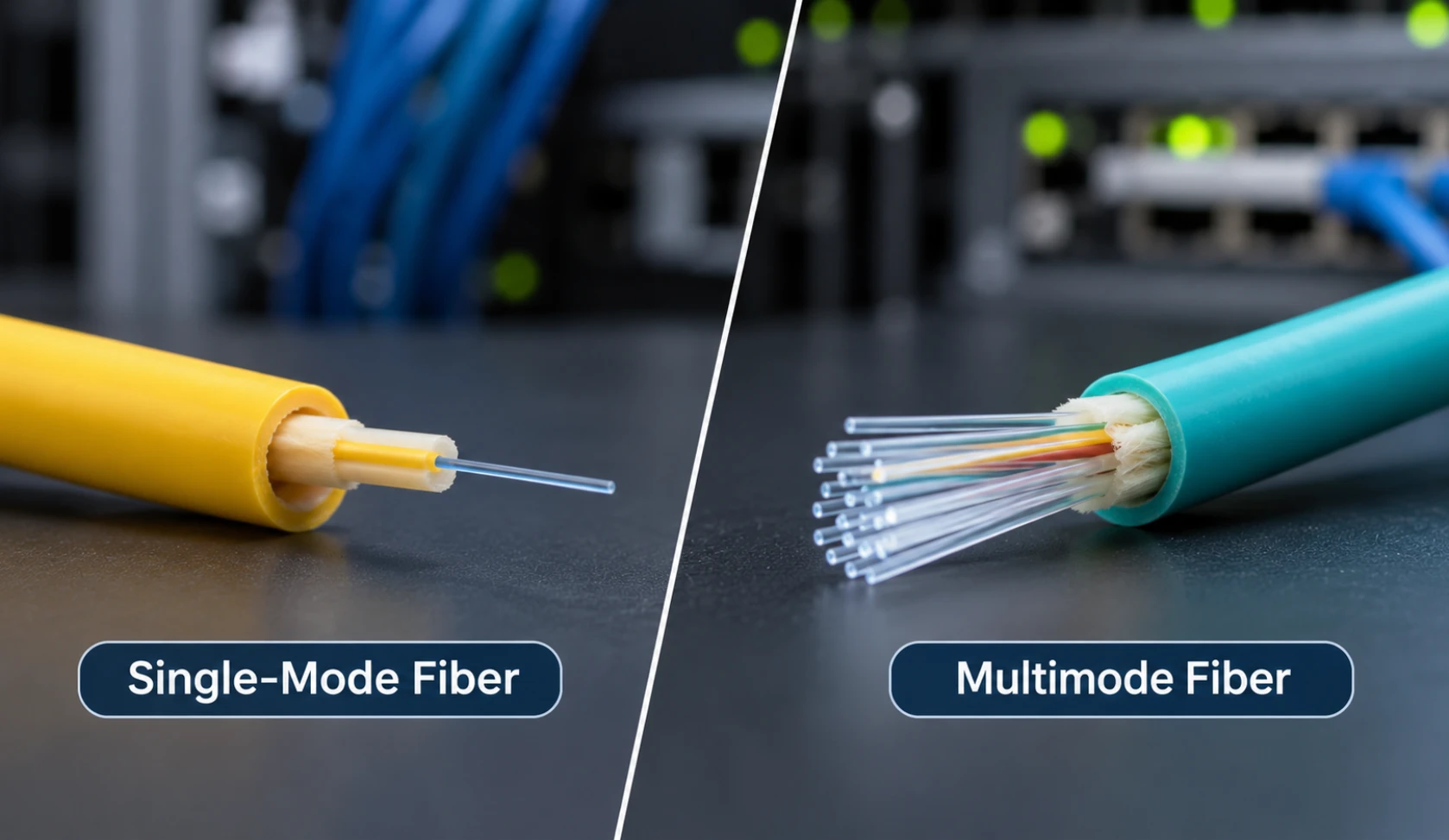
Single-mode and multimode fiber differ mainly in their core size and how light travels through the fiber.
Single-Mode Fiber
Single-mode fiber has a core approximately 9 microns in diameter. Its small core allows light to travel along a single propagation mode.
It is commonly selected for:
- Long-distance network connections
- Connections between buildings
- Telecommunications infrastructure
- Campus networks
- Applications requiring longer transmission distances
Single-mode fiber is generally identified by the OS classification, such as OS1 and OS2.
Multimode Fiber
Multimode fiber has a larger core, commonly 50 or 62.5 microns in diameter. It allows multiple light modes to travel through the fiber.
It is commonly used for:
- Data center connections
- Building network infrastructure
- Shorter-distance business network links
- Connections between network equipment
Multimode fiber is identified by OM classifications, including OM1, OM2, OM3, OM4 and OM5.
The right option should be selected according to the required link distance, data rate and compatible optical equipment. Neither type should be selected based on core size alone.
Understanding OM Fiber Categories
OM stands for Optical Multimode. The OM classification identifies different multimode fiber performance categories.
OM1 Fiber
OM1 is a legacy multimode fiber category with a 62.5-micron core and 125-micron cladding.
It may still be found in older business networks and existing installations. However, it is generally not the first choice for a new network design.
OM2 Fiber
OM2 typically uses a 50-micron core and 125-micron cladding. It offers higher modal bandwidth than OM1.
It may be present in older network infrastructure, but newer multimode categories are generally more suitable when planning higher-speed applications.
OM3 Fiber
OM3 is a laser-optimized multimode fiber designed for use with appropriate laser-based optical equipment.
It has a 50-micron core and supports higher bandwidth applications than earlier multimode categories. It is commonly used in enterprise networks and data centers.
OM4 Fiber
OM4 is also a laser-optimized 50-micron multimode fiber. It provides higher effective modal bandwidth than OM3, allowing longer supported link distances for certain applications.
It may be considered for data center and enterprise network designs where multimode fiber is appropriate.
OM5 Fiber
OM5 is a wideband multimode fiber category. It supports multiple wavelengths in the 850–950 nm range and is designed for applications that use shortwave wavelength division multiplexing.
It is a more specialized option, so its suitability depends on the network equipment and application.
Important: OM categories do not guarantee a particular network speed or transmission distance by themselves. Actual performance depends on the Ethernet application, transceivers, link design and installation conditions.
Understanding OS Fiber Categories
OS stands for Optical Single-Mode. OS1 and OS2 are common single-mode fiber classifications.
OS1 Fiber
OS1 is generally associated with indoor single-mode cable construction and is commonly found in existing installations.
It may be suitable for certain indoor network applications, depending on the cable specification and system requirements.
OS2 Fiber
OS2 is a low-attenuation single-mode fiber category commonly used for longer-distance applications. It is available in cable constructions designed for different installation environments.
It is often considered for campus networks, building-to-building connections and other applications where single-mode fiber is required.
When comparing OS1 and OS2, check the cable specification, attenuation requirements, installation environment and compatibility with the optical equipment.
Indoor vs. Outdoor Fiber Optic Cables
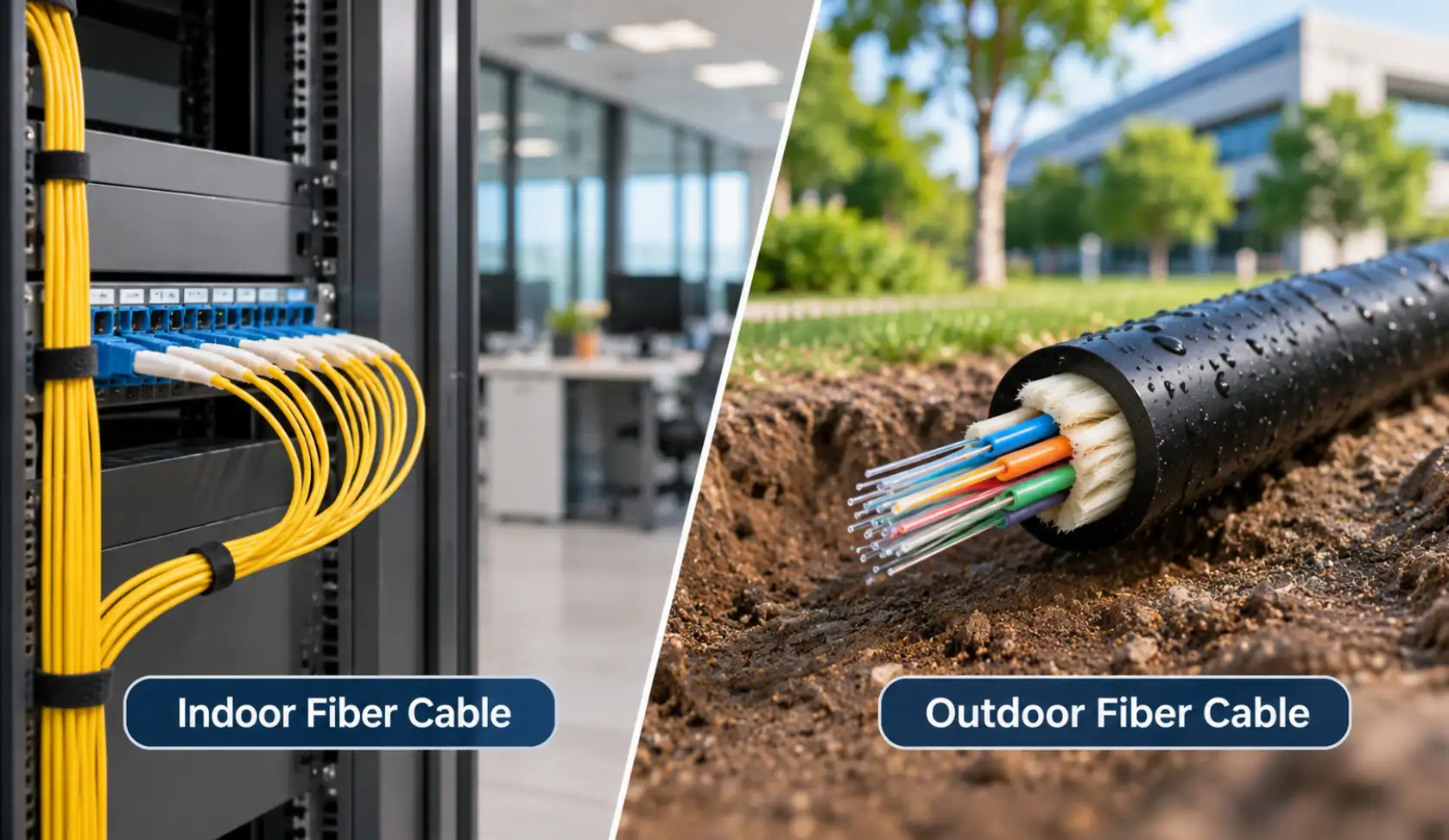
Fiber optic cables are also designed for different installation environments. An indoor cable and an outdoor cable may use the same optical fiber category but have different protective constructions.
Indoor Fiber Optic Cables
Indoor fiber cables are designed for installation inside buildings. Their construction and jacket ratings must be suitable for the building environment and applicable fire-safety requirements.
Common indoor cable considerations include:
- Plenum-rated cable
- Riser-rated cable
- General-purpose indoor cable
- Tight-buffered cable construction
The required rating depends on where the cable will be routed.
Outdoor Fiber Optic Cables
Outdoor fiber cables are designed to handle environmental conditions that indoor cables may not be built to withstand.
Depending on the installation, they may include:
- Water-blocking materials
- Moisture-resistant construction
- UV-resistant outer jackets
- Armored protection
- Loose-tube construction
Outdoor cable selection should account for exposure to moisture, temperature changes, physical damage and the installation route.
For connections that move from an outdoor environment into a building, the cable transition must follow applicable building and fire-safety requirements. An outdoor-rated cable should not automatically be assumed suitable for unrestricted indoor use.
Plenum vs. Riser Fiber Optic Cables
Plenum and riser are fire and installation ratings used for certain building cable applications. They are not separate optical fiber categories like OM or OS.
Plenum-Rated Fiber Cable
Plenum-rated cable is designed for installation in designated plenum spaces, which are areas used for environmental air circulation in buildings.
These spaces may include certain ceiling and underfloor areas. Cable installed in them must meet the applicable fire-safety requirements.
Riser-Rated Fiber Cable
Riser-rated cable is designed for vertical runs between floors in a building.
It is commonly identified by the OFNR or OFCR marking, depending on the cable construction.
The correct rating depends on the actual pathway and applicable code requirements. A cable suitable for one installation area may not be suitable for another.
What Does PVC Mean in Fiber Optic Cables?
PVC stands for polyvinyl chloride, a material used in some cable jackets.
PVC describes a jacket material, not an optical fiber category or a fire rating by itself.
A cable’s suitability for a particular building location depends on its complete construction and listing. For example, the presence of a PVC jacket alone does not establish that a cable is plenum-rated.
Always check the manufacturer’s cable specifications and required markings before installation.
How to Choose the Right Fiber Optic Cable
Selecting fiber optic cable requires more than comparing OM and OS numbers. The cable should match the network’s technical requirements and the physical installation environment.
Consider these factors before choosing:
- Transmission distance: Determine how far the data needs to travel between network endpoints.
- Required network speed: Identify the data rate the network must support.
- Optical equipment: Check that the fiber type is compatible with the transceivers and network devices.
- Installation environment: Decide whether the cable will be installed indoors, outdoors, underground, overhead or through building pathways.
- Cable protection: Consider whether water blocking, armoring or other protective features are required.
- Building ratings: Confirm whether the installation requires plenum, riser or another approved cable rating.
- Future requirements: Consider planned network upgrades and whether the selected infrastructure will meet expected needs.
A cable that works for one network may not be suitable for another. Reviewing the complete installation requirements before purchasing materials can help avoid compatibility and performance problems.
Common Fiber Optic Cable Selection Mistakes
A few mistakes can create problems during installation or future network upgrades.
- Choosing only by price: A lower-cost cable may not meet the required performance or environmental specifications.
- Ignoring equipment compatibility: The fiber type and optical transceivers must work together.
- Confusing OM and OS classifications: OM identifies multimode fiber, while OS identifies single-mode fiber.
- Ignoring cable ratings: An optical fiber category does not tell you whether its jacket is suitable for a plenum, riser or outdoor environment.
- Overlooking the installation route: Cable construction and protection must match the physical pathway.
- Skipping testing: Installed fiber links should be inspected and tested using methods appropriate to the project requirements.
When Should You Consult a Fiber Optic Installation Professional?
Fiber optic installation involves more than selecting a cable. The project may require route planning, cable placement, termination, splicing, testing and troubleshooting.
A professional assessment can help determine the appropriate fiber type, cable construction and installation method for the network.
Business Communication Solutions (BCS) provides fiber optic cabling services that include installation, fusion splicing, termination, testing, troubleshooting and repair. The company’s fiber optic cabling services page provides further information about its work.
If your business is planning a new fiber connection, upgrading existing infrastructure or resolving a fiber network issue, you can review BCS’s Fiber Optic Cabling Installation and Maintenance Services page to learn more.
Frequently Asked Questions
1. What are the main types of fiber optic cables?
The two main optical fiber types are single-mode and multimode. Single-mode includes OS classifications, while multimode includes OM classifications such as OM1, OM2, OM3, OM4 and OM5.
2. What is the difference between OM3 and OM4 fiber?
Both are laser-optimized multimode fibers with a 50-micron core. OM4 has higher effective modal bandwidth than OM3, which can support longer link distances for certain applications.
3. What is the difference between OS1 and OS2 fiber?
OS1 and OS2 are single-mode fiber categories with different cable and attenuation characteristics. OS1 is commonly associated with indoor cable construction, while OS2 is commonly used for low-attenuation applications, including longer-distance links. Always check the specific cable’s construction and performance specifications.
4. Is single-mode fiber better than multimode fiber?
Neither is automatically better for every project. Single-mode is commonly used for longer-distance links, while multimode is often used for shorter-distance applications. The correct choice depends on distance, network speed, equipment and project requirements.
5. What is the difference between indoor and outdoor fiber optic cables?
Indoor cables are designed for building installations and must meet the required building ratings. Outdoor cables are constructed to handle environmental conditions such as moisture and temperature changes. Their suitability depends on the installation route and cable specifications.
6. What is the difference between plenum and riser fiber cables?
Plenum-rated cables are designed for designated air-handling spaces, while riser-rated cables are designed for vertical pathways between floors. The required rating depends on the building pathway and applicable codes.
7. How do I choose the right fiber optic cable for my business?
Start by identifying the required network speed, transmission distance, optical equipment and installation environment. Then compare the fiber category, cable construction and required safety ratings before selecting the cable.
Related Guides
- Fiber Optics: The Backbone of Modern Networks
- Singlemode vs. Multimode Fiber
- Outside Plant Fiber Optic Cable
- Outdoor-Rated Fiber for Commercial Installations
- How Fiber Optic Installation Can Transform Your Business Connectivity
- Fiber Optic Termination: Best Practices for Reliable Connections
- Why You Need to Install Fiber Optic Cables for Internet
- Fiber Optic vs. Copper Against Lightning